Est. 1938 | Washington | 922,651 acres
Rising from wild Pacific beaches to glacier-capped peaks and dripping temperate rainforests, Olympic National Park protects one of the most ecologically diverse landscapes in the entire United States. Located on Washington’s Olympic Peninsula, the park encompasses three distinct ecosystems: rugged coastline, old-growth rainforest, and alpine mountains. Moss-draped trees tower over fern-filled valleys, pelicans patrol sea stacks along the coast, and snowfields cling to the Olympic Mountains year-round. Vast, varied, and exotic, Olympic National Park offers a rare opportunity to experience dramatically different environments within a single protected landscape.
Olympic National Park does not have a single main entrance or a central through-road; instead, access is provided by a network of highways that loop around the Olympic Peninsula with spur roads leading into specific park areas. U.S. Highway 101 forms the primary ring road around the park, connecting most access points and nearby towns such as Port Angeles, Forks, and Kalaloch. From Highway 101, short but often winding spur roads lead into major destinations, including Hurricane Ridge Road near Port Angeles, Hoh River Road to the Hoh Rain Forest, Sol Duc Road into the Sol Duc Valley, and Kalaloch Road to the Pacific coast.
There are three visitor centers throughout the park. The primary visitor center is located in the town of Port Angeles with another in the Hoh Rainforest and the third high up in the Olympic Mountains. Travel between these park regions can take several hours, making advance planning essential, as visitors must often exit one area and drive around the park’s perimeter to reach another.

Must-see highlights in Olympic National Park
1
Hoh Rainforest—The Hoh Rain Forest is one of the finest examples of temperate rainforest in the world. Massive Sitka spruce and western hemlock trees rise from a forest floor thick with moss, ferns, and nurse logs. Short trails like the 0.8-mile acclaimed Hall of Mosses Trail and longer backcountry trails like the 17-mile Hoh River Trail showcase the lush, otherworldly character of this thriving ecosystem.

2
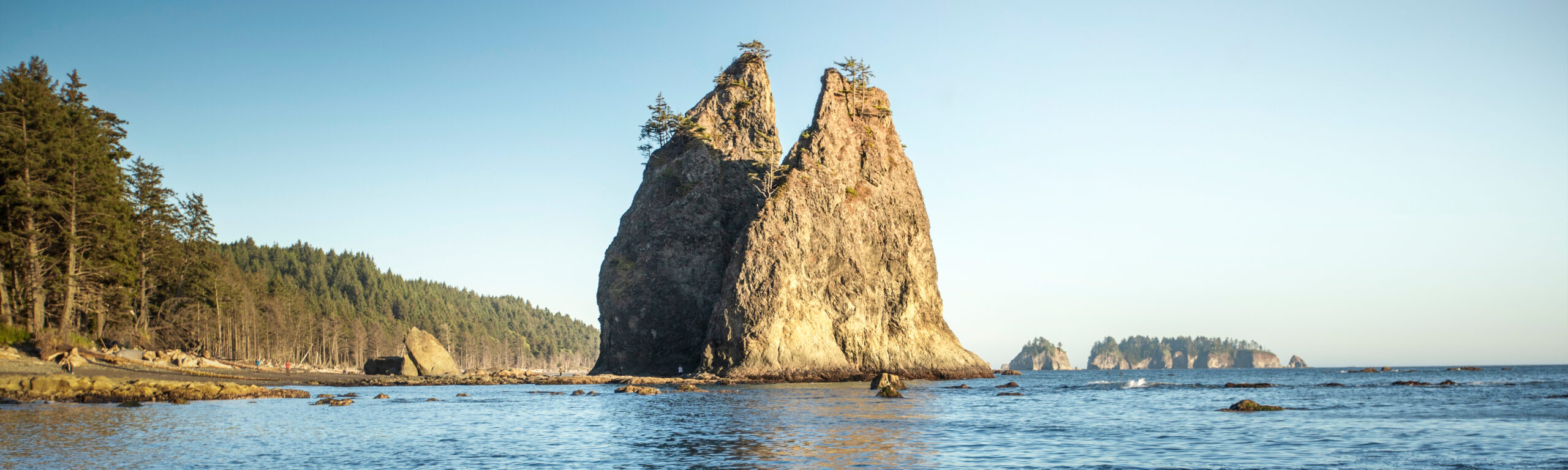
Rialto Beach—Rialto Beach is a dramatic stretch of Pacific coastline defined by driftwood, crashing surf, and towering sea stacks. Most famous for its Hole-in-the-Wall sea arch, Rialto beach is exceptional at low tide, revealing tide pools filled with colorful marine life and providing access to amazing rock formations normally unaccessible.

3
Hurricane Ridge—Located high in the Olympic Mountains, Hurricane Ridge offers sweeping views of jagged peaks, alpine meadows, and distant glaciers. On clear days, visitors can see across the Strait of Juan de Fuca to Vancouver Island. Hiking, snowshoeing, and wildlife viewing are popular here, depending on the season.

4
Sol Duc Falls Trail—Totaling only 1.5 miles roundtrip, the Sol Duc Falls Trail leads to one of the park’s most picturesque waterfalls, where water cascades through a narrow, moss-lined gorge.

5
Lake Crescent—A deep, glacially carved lake with clear blue water framed by forested mountains, Lake Crescent offers a chance to engage in water sports include kayaking, paddle boarding, and swimming in summer. And nearby hiking trails such as Marymere Falls Trail are a great way to dry off.
Wildlife Highlights in Olympic National Park
From coast to crest, Olympic National Park supports an impressive range of wildlife across its diverse ecosystems. While forest animals are elusive, deer are often found along high elevation trails in the early morning. Marine wildlife however are usually spotted all day long along the coast and spike in activity near sunset.
- Mammals: Roosevelt elk, black bears, black-tailed deer, river otters, harbor seals, sea lions, sea otters, and migrating gray whales
- Birds: bald eagles, marbled murrelets, puffins, pelicans, and a wide variety of other seabirds
- Invertebrates: starfish, anemones, crabs, and sea urchins
- Plants: Old growth sitka spruce, western hemlock, sword fern, deer fern, and nurse logs covered in moss.
Best time to visit Olympic National Park
Olympic National Park is open year-round but can shut down regionally during winter storms, making summer and fall the best time to experience the full extent of the park’s geographic diversity.
- Spring (April to June): Spring brings blooming wildflowers and rushing waterfalls, though lingering snow may limit access to higher elevations. Temperatures are cool, generally in the 50s–60s°F (10–18°C), and rain is still common.
- Summer (July to September): Arguably the best time to visit, summer is the most popular time season, with mild temperatures typically ranging from the 60s to low 70s°F (15–22°C). Snow has usually melted from higher elevations, making trails accessible and replete with alpine wildflowers. Rainfall is generally lower than the rest of the year during the summer months meaning the park is in full swing and fully operational.
- Fall (October): As the shortest season, fall offers fewer crowds, vibrant autumn colors at lower elevations, and dramatic coastal storms. Rainfall increases, and temperatures cool into the 40s–50s°F (4–12°C). Hurricane Ridge sees the first snowfall in mid-October, but has been known to see snow as early as late-September during colder years.
- Winter (November to March): Winter is very wet and rainy throughout the park turning to large accumulation of snow at higher elevations. Hurricane Ridge becomes a winter recreation area, while many trails and roads close due to snow and storms.
How long should I visit Olympic National Park?
A minimum 3-day visit is a must for Olympic National Park. Because the park is so large and sprawling extra time allows for greater exploration into the isolated regions. For instance, spend one day along the coast, one day in the heart of the rainforest and the last day along Lake Crescent or Hurricane Ridge. There is plenty to do in each region to consume a full day. A longer 4–5 day trip is ideal for exploring all three major regions—mountains, rainforest, and beaches—without rushing, or planning a backcountry excursion along the Hoh River Trail up to Mount Olympus.
Getting to Olympic National Park
Olympic National Park is located on the Olympic Peninsula in northwestern Washington. The nearest major airport is Seattle-Tacoma International Airport (SEA). The park has multiple entrances rather than a single main gate so visitors typically reach the park from Seattle by either taking a car ferry across Puget Sound, driving south and around the peninsula to the town of Forks, or north and around to Port Angeles. Because the park is enormous and roads are rural, travel between areas can take several hours.
Where to stay in Olympic National Park
Lodging—Olympic offers several in-park lodges around Lake Crescent, Sol Duc, and the coast. Nearby towns such as Port Angeles, Forks, and Sequim provide additional hotel and cabin options.
- Kalaloch Lodge—Kalaloch, 64 units (rooms and cabins), open year-round
- Sol Duc Hot Springs Resort—Sol Duc Valley, 32 units (suite and cabins), open April–October
- Lake Crescent Lodge—Lake Crescent, 55 units (rooms and cabins), open May–December
- Log Cabin Resort—Lake Crescent, 28 units (rooms and cabins), open May–September
Campground—The park features numerous campgrounds throughout the park. Many are open year-round, but must be reserved in advance during peak summer months. All other times and places are first come, first serve. Backcountry camping is permitted with a wilderness permit and allows overnight stays in remote rainforests, alpine basins, and along the coast.
- Deer Park Campground—Deer Park Area, 14 sites (tent only), open June–October
- Fairholme Campground—Lake Crescent, 88 sites (RV and tent), open May–September
- Graves Creek Campground—Quinault Area, 30 sites (tent only), open year-round
- Heart O’ the Hills Campground—Heart O’ the Hills Area, 97 sites (RV and tent), open year-round
- Hoh Rain Forest Campground—Hoh Rain Forest, 78 sites (RV and tent), open year-round
- Kalaloch Campground—Kalaloch Area, 170 sites (RV and tent), open year-round
- Log Cabin Resort RV & Campground—Lake Crescent, 38 sites (RV and tent), open May–October
- Mora Campground—Mora Area, 94 sites (RV and tent), open year-round
- North Fork Campground—Quinault Area, 9 sites (tent only), open year-round
- Ozette Campground—Ozette Area, 15 sites (RV and tent), open year-round
- Queets Campground—Queets Area, 20 sites (tent only), open year-round
- Sol Duc Hot Springs RV Park & Campground—Sol Duc Valley, 82 sites (RV and tent), open March–October
- South Beach Campground—Kalaloch Area, 55 sites (RV and tent), open May–October
- Staircase Campground—Staircase Area, 49 sites (RV and tent), open May–October
When should I book my trip to Olympic National Park?
Summer lodging and campsites often fill months in advance, especially along the coast and near popular trailheads. Spring, fall, and winter generally offer more availability, but winter visits require trip flexibility due to weather-related closures. So, consider booking summer trips 6 months out, while it’s best to book winter trips 4–6 weeks out to assess weather patterns and closures.
How much should I budget for Olympic National Park?
A 3-day trip to Olympic National Park booked 6 months in advance can cost roughly $500–$750 depending on your required needs. Here is a range of what to expect:
| Roundtrip Airfare to Seattle-Tacoma International Airport (SEA) | $170–$300 |
| Lodging | $150–$300+/night |
| Campsite | $15–$44/night |
| Car Rental | $55–$100/day |
| Meals | $15–$20/meal |
| Entrance Fee | $30/vehicle |
Packing list for Olympic National Park
Each park requires different gear for its unique characteristics. For Olympic National Park, we wouldn’t want to be caught without hiking shoes, hiking poles, rain coat, beach sandals, towel, a hat, and sunglasses.
Want to learn more? Check out my detailed trip report for a peek into my trip to Olympic.
For more detailed information on Olympic National Park, visit the official park website.

Looking for more?
To view more photos of this park and the rest of America’s 63 national parks, check out my Park Portraits project.