Est. 1916 | Hawai’i | 33,265 acres
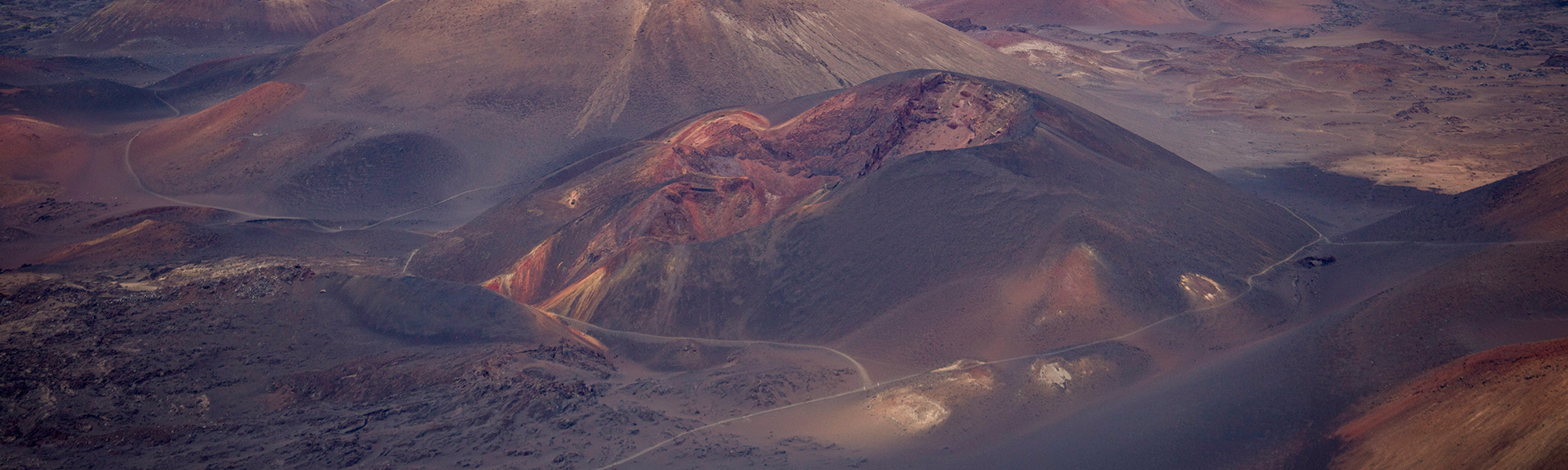
Rising above the clouds on the island of Maui, Haleakala National Park protects the dramatic extremes of the park’s namesake, the Haleakala Volcano. Expect to find everything from the barren volcanic wilderness of the summit crater to the lush, waterfall-lined forests of Kipahulu along the coast. Giant volcano cinder cones, sweeping crater views, rare native species, and black-sand shorelines reveal the land’s unique natural value.
The volcano itself dominates the island of Maui. Yet partitioned into two distinct districts, the national park preserves only a slice of this vast wilderness. As you would expect, the Summit District high atop Haleakala encompasses the crater-lands of the dormant volcano on the western end of the park. Here, visitors can witness one of the most awe-inspiring sunrises in the world from 10,023 feet above sea level. Meanwhile stretching down to the ocean, the Kipahulu District covers the remote coastal rainforests in the east.
Visitors can drive to both the summit and the coast along maintained paved roads, though such a journey between the districts can take over 3 hours. Thankfully, each district has its own visitor center and accompanying trails for those short on time.

Must-see highlights in Haleakala National Park
1
Haleakala Summit—At over 10,000 feet, the summit provides sweeping views across a massive volcanic landscape carved by erosion and past eruptions. Sunrises and sunsets here are legendary—clouds light up in vivid pinks, oranges, and purples as the sun moves across the sky. But plan ahead as reservations are required for sunrise from 3–7 a.m. Sunrise reservations can be purchased on Recreation.gov.
2
Sliding Sands Trail (Keonehe‘ehe‘e Trail)—One of the park’s signature hikes, Sliding Sands Trail descends into the colorful summit crater basin with views of red and black cinder cones, lava flows, and desert-like volcanic terrain. Plan for a full day on this trail as this out-and-back trail measures 6 miles one way. Look out for the rare Haleakala silversword, one of Hawai’i’s endemic plants grown only on these slopes.

3
Pipiwai Trail—Get ready to be blown away. This 4-mile round-trip trail leads past an ancient sprawling banyan tree through towering bamboo groves to Waimoku Falls, a magnificent 400-foot waterfall dropping down a sheer lava cliff. This is one of the most iconic rainforest hikes in Hawaiʻi.

4
Kuloa Point Trail—This easy half-mile trail located along the Hana Highway in the Kipahulu district, showcases the lush scenic Pools of ‘Ohe’o, cascading waterfalls that spill into terraced basins overlooking the Pacific Ocean.

5
Hosmer Grove—Near the Summit District’s park entrance, visitors can stroll a cool, forested grove of non-native trees once used to control erosion, that now house the rare honeycreepers, a family of endangered birds native to Hawai’i. Inside the grove, short trails explore the mixed forest and offer good birdwatching opportunities.
Wildlife in Haleakala National Park
Hawai’i is no stranger to wildlife. Haleakala alone features exotic species found nowhere else on earth. Most notable are the island’s honeycreepers, a mix of six species of Hawai’ian song birds, and the endemic Haleakala silversword plant, shrub that blooms once before spreading seeds and dying high on the volcano’s crater slopes.
- Birds: ‘Apapane and ‘i‘iwi (honeycreepers), nene (Hawaiian goose), ua’u (Hawaiian petrel)
- Insects: Haleakala flightless moth, Hawaiian wolf spider
- Flora: Silversword, koa and ‘ohi’a forests, bamboo forest
Best time to visit Haleakala National Park
Near the equator, Haleakala sees little temperature fluctuation between the seasons. If anything, weather and rain ebb and flow more so throughout the year. Winter tends to be wetter while summer is generally drier, making fall one of the best times to visit with less crowds, clearer weather, and warmer summit temperatures.
- Spring (March to May): Springtime brings mild temperatures on the summit—usually in the 40s–60s°F (4–16°C)—and warm conditions in Kipahulu, typically in the 70s–80s°F (21–29°C). Rain showers are common in the rainforest, while clear mornings often prevail at higher elevations.
- Summer (June to August): The summer months are warm in the lowlands but cool at the summit, where temperatures often range between the 40s–70s°F (4–21°C). Afternoon clouds are frequent, and UV exposure is very strong. This is a popular season for sunrise viewing so plan ahead.
- Fall (September to October): Stable weather and fewer crowds defines autumn in Haleakala. Summit temperatures once again hover in the 40s–60s°F (4–16°C), while Kipahulu remains warm and humid. Visibility is often excellent for stargazing.
- Winter (December to February): Prepare for colder summit conditions, including occasional frost or even light snow in the winter months. Temperatures often drop into the 30s–50s°F (−1 to 10°C) at the summit. But lower elevations remain mild with rainfall increasing in the Kipahulu district.
How long should I visit Haleakala National Park?
A 2–3 day visit is your best bet at experiencing the fullness of Haleakala. This will allow one day to drive up the summit, watch sunrise or sunset, and hike short crater-rim trails, another day to venture over to Kipahulu and explore the coast and Pipiwai Trail, and final day to add margin for weather obstruction or travel delays.
Getting to Haleakala National Park
The park is located on the island of Maui in the Hawaiian Islands. Maui has two airport options—Kahului Airport (OGG) in the west and Hana Airport (HNM) in the east. Though the Hana Airport is closer to the Kipahulu District, it is far more expensive than the more popular Kahului Airport.
The park contains two main districts reached by separate roads. The Summit District is about 1.5 hours from Kahului Airport along a steep, winding road (State Highway 378) that climbs more than 10,000 feet. The Kipahulu District lies around the island along the Hana Highway, approximately 2–3 hours from Kahului depending on conditions and stops. A rental car is essential for exploring the park, as there is no public transportation to either district.
Note: Even though maps may show a roadway circumnavigating the entire island, the western route along the Piilani Highway is not advisable for many conventional vehicles. Check with your rental company before attempting this route to reach Kipahulu. Otherwise, opt for the longer, but easier, eastern route along Hana Highway (HI-360).
Where to stay in Haleakala National Park
Lodging—There are no hotel accommodations inside the park. Visitors typically stay in nearby communities such as Kahului, Paia, Makawao, Kula, or Hana.
Campground—Each district hosts one developed campground. Both require advance reservations.
- Hosmer Grove Campground—Summit District, 6 sites (Tent only), open year-round
- Kipahulu Campground—Kipahulu District, 21 sites (Tent only), open year-round
When should I book my trip to Haleakala National Park?
Reservations for a trip to Haleakala National Park can be tricky, especially in the spring and fall when campsites are a hot commodity. Because campsite permits are not available until 30 days prior to your trip date, you will need to book your flight first. So the trick of the trade is to book your flight and rental car as soon as possible for lower fares around 3–6 months in advance. And then set a reminder to book your campsite exactly 30 days before your flight date.
If you plan to stay in town at a hotel or rental home, your options are not as competitive, but much more pricey. But be aware lodging near the park fills quickly during major holidays, summer months, and winter travel season.
Sunrise viewing at the summit is also extremely competitive. Permits are required for 3–7 a.m. and are released on Recreation.gov both 60 days out and 2 days out. Each permit allows a single vehicle passage to the summit and is valid only for a single day. Permit holders cannot purchase another permit within 3 days of original reservation, so each reservation is at the mercy of the weather conditions.
How much should I budget for Haleakala National Park?
A 2–3 day trip to Haleakala National Park booked 6 months in advance can cost roughly $750 depending on your required needs. Because trips to Hawai’i are expensive, consider camping or backpacking to save several hundred dollars. Or combine forces with a friend or family member to share lodging costs. Here is a range of what to expect:
| Roundtrip Airfare to Kahului Airport (OGG) | $300–$500 |
| Lodging | $180–$350/night |
| Campsite | $20/night |
| Car Rental | $60–$90/day |
| Sunrise Permit | $1/vehicle |
| Meals | $20–$30/meal |
| Entrance Fee | $30/vehicle |
Packing list for Haleakala National Park
Each park requires different gear for its unique characteristics. For Haleakala National Park, we wouldn’t want to be caught without hiking shoes, raincoat, light jacket, sandals, sunscreen, a hat, and sunglasses.
Want to learn more? Check out my detailed trip report for a peek into my trip to Haleakala.
For more detailed information on Haleakala National Park, visit the official park website.

Looking for more?
To view more photos of this park and the rest of America’s 63 national parks, check out my ParkQuest project.