Est. 1980 | Alaska | 3,674,529 acres
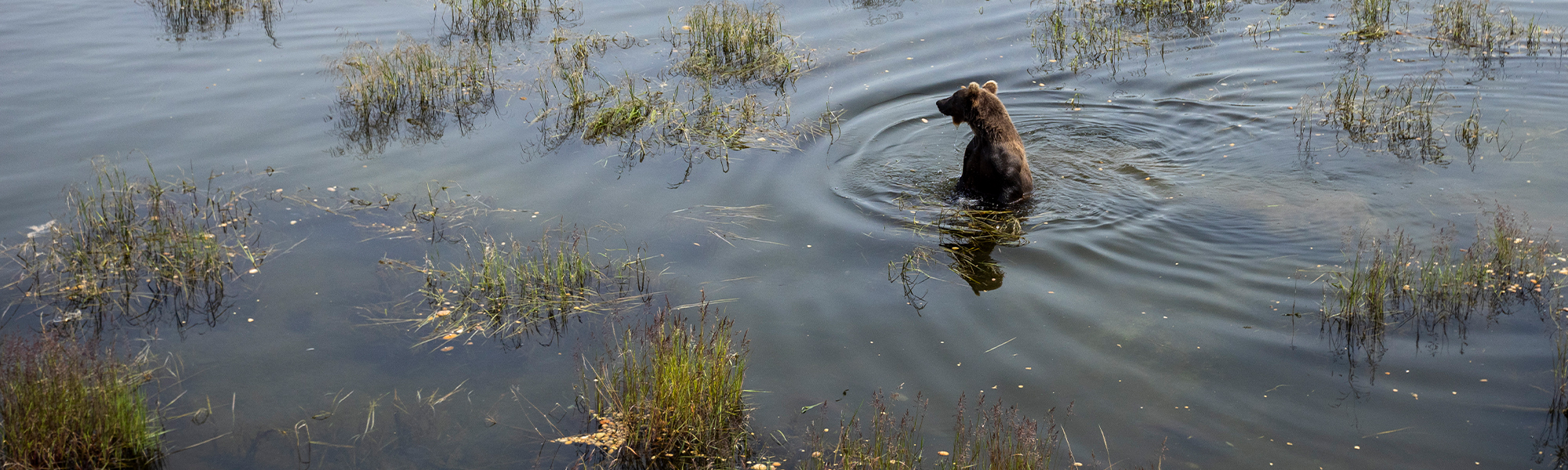
Alaska at its wildest, Katmai National Park & Preserve is an expanse chock-full of volcanic landscapes, salmon-filled rivers, and some of the best brown bear viewing in the world. Best known for Brooks Falls, where bears gather in summer to fish for leaping salmon, Katmai also protects the dramatic Valley of Ten Thousand Smokes, a volcanic ash flow left from one of the largest eruptions of the 20th century.
Located on the remote Alaska Peninsula, Katmai has no road connections—visitors enter by either plane or boat, keeping the wilderness largely untouched. Brooks Camp is the central hub of the park, located on Naknek Lake. Here, the Brooks River spills into Naknek Lake over the iconic Brooks Falls. Every summer, as salmon migrate upriver to spawning grounds in Lake Brooks, they must jump the falls, setting a massive feast for Alaska’s top predator, the grizzly bear.
But just twenty miles southeast lies the original reason Katmai was first inducted in the national park system. The park’s Valley of Ten Thousand Smokes contains 15 active volcanoes, making it one of the world’s most concentrated volcanic regions. It wasn’t until after Katmai was designated a national park for its geothermal nature that it became known for its thriving salmon and brown bear populations, garnering global attention for its wildlife conservation. Today, the park is a paradise for wildlife watchers, anglers, paddlers, and backcountry adventurers seeking solitude and raw nature.

Must-see highlights in Katmai National Park
1
Brooks Falls—The iconic bear-viewing site where dozens of brown bears congregate each July and September to catch salmon mid-leap. Two viewing decks (Falls Platform and Riffles Platform) provide world-class wildlife photography opportunities. Due to its high popularity, the Upper Falls viewing platform is managed by an in-person rudimentary reservation list, much like a restaurant, rotating parties every 20–30 minutes. This is plenty of time to enjoy the view from Upper Falls, but there is no limit to how often parties can reenter the reservation system. The Riffles Platform is an excellent place to enjoy the bears while waiting for Falls Platform.

2
Valley of Ten Thousand Smokes—Riddled with thousands of steam vents after the 1912 Novarupta eruption—the largest in modern history—explorer Robert Griggs named the region Valley of Ten Thousand Smokes. The valley still showcases ash deposits and eroded canyons to this day. Short hikes and viewpoints are accessible by ranger-led bus tours from Brooks Camp in summer. Additionally, aerial views of Mount Katmai’s crater summit is particularly photogenic from charter flights.
3
Hallo Bay—Hallo Bay is a coastal bear-viewing hotspot along the eastern coast of the park where brown bears feed on sedges, clams, and salmon. Accessible only by private boat or floatplane, these areas offer intimate encounters with wildlife. Anyone venturing into this region of the park should be informed on bear safety and behavior since these coastal bears are not as familiar with human activity as their counterparts nearer to Brooks Camp.
Best time to visit Katmai National Park
Katmai is best visited in the late summer months (late-June through September) when facilities, trails, and transportation is in full swing. Bear-viewing at Brooks Falls peaks in early July and again in September as thriving populations feast on salmon migrations. Coastal regions can see bears anytime June through September. As a rule of thumb, coastal temperatures are generally more stable than inland mountainous temperatures.
- Spring (May to early-June): With daytime temperatures ranging from 45–55ºF, snow begins melting in May. In conjunction with warming temperatures, bear activity increases along the coast in early June (Hallo Bay). Brooks Camp typically opens in May, gearing up for the coming influx of summertime bears. May is usually one of the driest months .
- Summer (late-June to early-August): In summer, bears move inland with peak bear activity at Brooks Falls in early to mid-July. During this time, weather is mild (50–70°F), though rain is frequent. August is typically the wettest month of the year, followed closely by July. As August approaches, bears return to the coast (Geographic Harbor) in search of clams and coastal salmon migrating upland.
- Fall (late-August to September): September brings a second inland boom of bear activity as salmon spawn upstream in the rivers. Restless wildlife, brilliant tundra colors and fewer crowds make this an excellent time for photography. Temperatures return to 45–55ºF as in the spring.
- Winter (October to April): Though open to visitors year-round, the park is largely inaccessible in the winter. Bears are present through December but operations at Brooks Camp close down for the year by October. Heavy snow, freezing temperatures, and short daylight hours dominate the landscape. Hardy, determined travelers can arrive via ski plane charters.
How long should I visit Katmai National Park?
Day trips from King Salmon, Homer, or Anchorage are common for bear viewing. However 2–3 days at Brooks Camp allows time to explore the falls, take a Valley of Ten Thousand Smokes bus tour, and enjoy evening wildlife viewing away from crowds. For those wanting to experience coastal or backcountry destinations allowing 5–7 days is best.
Getting to Katmai National Park
There are generally two main approaches to Brooks Camp. Visitors can either charter a private sea plane directly to the area via King Salmon, Homer, Anchorage, or even Port Alsworth in Lake Clark, or fly commercially to King Salmon and book a ferry ticket to Brooks Camp along the Naknek River with Katmai Water Taxi. Chartering a private flight is more expensive, but also more dependable and convenient. Transportation for overnight trips are best conducted through King Salmon or Anchorage.
Mandatory Bear Orientation: Those venturing to Brooks Camp are required to attend a short bear orientation at the visitor center before exploring the grounds. During this 15-minute instructional class, ranger staff inform visitors on proper bear etiquette while in bear territory. In the entire history of the park, there has only been one fatality by brown bear attack, largely due to bear orientation classes like these. In addition to Brooks Camp, there is another visitor center in King Salmon and one in the Valley of Ten Thousand Smokes (though Brooks Camp is the only location to offer bear orientation classes).
Where to stay in Katmai National Park
Lodging—Though private lodges are dispersed throughout and nearby the park on private land, Brooks Lodge and Grosvenor Lodge are the only lodges operating inside park boundaries.
- Brooks Lodge—16 cabins (sleeps 4 each), open May–September
- Grosvenor Lodge—3 cabins (sleeps 3 each), open June–September
Campground—Brooks Camp Campground is the only established campground within park boundaries. There are no designated campsites, just a large area roped off by electrical fencing that can hold 60 people each night. Food must be stored in provided bear-proof caches and can only be eaten in designated areas to limit bear encounters in the campground. Reservations can be made through Recreation.gov.
- Brooks Camp Campground—60-person limit (tent only), open May–October
When should I book my trip to Katmai National Park?
When you book your trip depends largely on your length of stay and desired location. If you simply want a day trip to Brooks Camp, reservation can be made a week out. However, staying at Brooks Camp is highly competitive and must be booked in advance. It is wise to book a cabin at Brooks Lodge at least a year in advance. Brooks Camp Campground on the other hand opens reservations for the entire summer season in early January, usually selling out for the summer in a matter of minutes.
I suggest securing overnight accommodations first and building your itinerary around those dates.
A Note on Trip Insurance: Remote Alaskan vacations are not only expensive, but also precarious. Inclement weather can delay and cancel plans. Most lodges and flight charters do not reimburse for weather challenges unless they specifically cancel your reservation. Simply put, there are no refunds for no-shows if your flight to Alaska is delayed or canceled. So trip insurance might be a good idea if traveling during inclement weather months or have tight connections. For example, my chartered flight to Lake Clark was almost in jeopardy since my flight to Anchorage was nearly delayed an entire day due to plane maintenance. If you don’t plan to pay for trip insurance, consider building a day of margin into the start and end of your trip to account for any mishaps.
How much should I budget for Katmai National Park?
Katmai is an expensive park to visit. A 3–5 day trip booked 12 months in advance can cost at least $1500 depending on your required needs. To keep costs down, consider camping overnight or traveling with a group of family or friends to share the costs of lodging and charter flights. Here is a range of what to expect:
| Roundtrip Airfare to Anchorage | $350–$500/person |
| Roundtrip Airfare Anchorage to King Salmon | $450–$700/person |
| Roundtrip Day-trip Charter to Brooks Camp | $2,000–3,000/plane |
| Brooks Lodge | $1,150/cabin-night |
| Brooks Camp Campsite | $18/person-night |
| Meals | $25–$45/meal |
| Entrance Fee | FREE |
Packing list for Katmai National Park
Each park requires different gear for its unique characteristics. For Katmai National Park, we wouldn’t want to be caught without hiking shoes, a water bottle, warm layers, bug spray, rain coat, a hat, binoculars, and sunglasses.
Want to learn more? Check out my detailed trip report for a peek into my trip to Katmai.
For more detailed information on Katmai National Park, visit the official park website.

Looking for more?
To view more photos of this park and the rest of America’s 63 national parks, check out my ParkQuest project.