Est. 1935 | Virginia | 200,195 acres
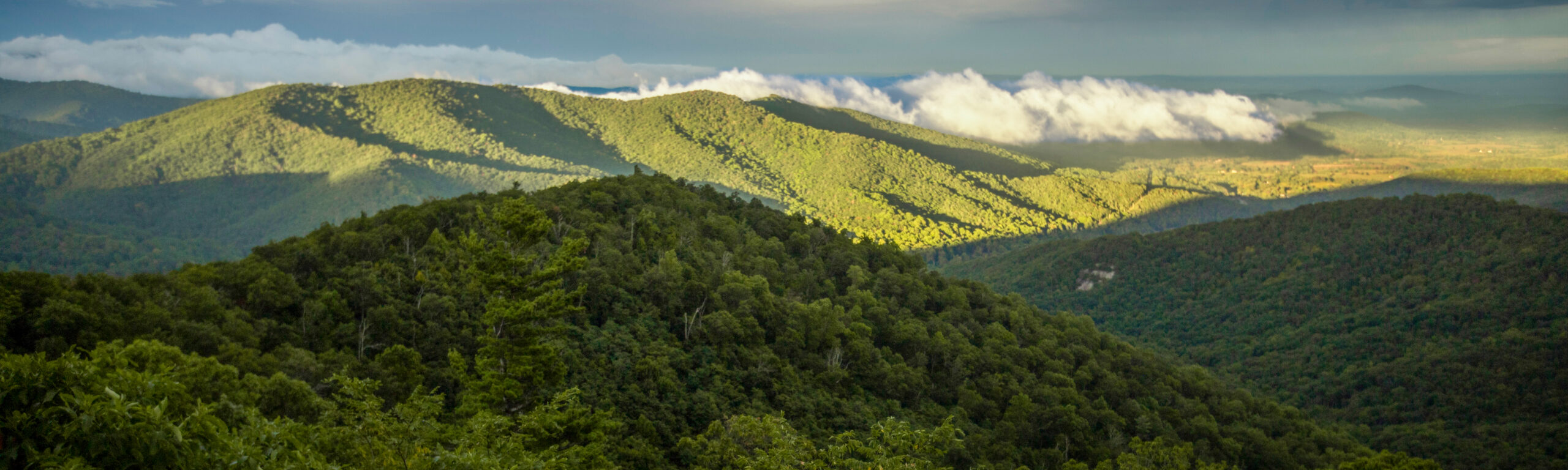
Stretching along the crest of Virginia’s Blue Ridge Mountains, Shenandoah National Park protects a long, narrow landscape of forested ridgelines, quiet hollows, cascading waterfalls, and sweeping valley views. The park is best known for Skyline Drive, a scenic roadway that runs the length of the mountains and offers access to overlooks, trailheads, and campgrounds. Beneath the ridges, hardwood forests blanket the slopes, erupting in brilliant color each autumn and sheltering abundant wildlife year-round. With its mix of easy roadside access and deep backcountry solitude, Shenandoah is one of the most approachable yet rewarding national parks in the eastern United States.
Following the spine of the Blue Ridge Mountains for 105 miles, Shenandoah creates a long corridor rather than a compact park. Skyline Drive runs north to south, connecting nearly all major overlooks, visitor centers, campgrounds, and trailheads. There are four main entrances—Front Royal (north), Thornton Gap, Swift Run Gap, and Rockfish Gap (south)—allowing visitors to enter and exit at different points. There are two visitor centers in the park. Dickey Ridge Visitor Center and Harry F. Byrd Sr. Visitor Center. Each provides exhibits, maps, and trail information. Most hikes descend from Skyline Drive into wooded valleys and then climb back to the ridge, making elevation change a defining feature of the park.

Must-see highlights in Shenandoah National Park
1
Skyline Drive—Skyline Drive is the park’s signature feature, winding 105 miles along the mountain crest with more than 70 overlooks. The drive offers expansive views of the Shenandoah Valley to the west and the Piedmont to the east creating especially striking vistas at sunrise and sunset.
2
Old Rag Mountain—One of the park’s most popular hikes, Old Rag features steep climbs, rocky scrambles, and panoramic summit views. The nearly 10-mile loop is demanding but rewards hikers with one of the best 360º views in the park. Because Old Rag is so popular and precarious, every individual hiker must obtain a day-use permit on Recreation.gov in order to hike the trail between March 1 and November 30. 800 permits are released each day. Half are available 30 days in advance and half are released 5 days in advance.

3
Hawksbill—At 4,051 feet, Hawksbill is the highest point in the park. The moderate 1.5-mile hike leads to stone overlooks with sweeping views across the Blue Ridge Mountains. This is a great destination for sunrise or sunset.

4
Dark Hollow Falls—Dark Hollow Falls is one of Shenandoah’s most accessible waterfalls. A short but steep 1.5-mile hike leads to cascading falls tucked into a shaded forest hollow near Big Meadows. This waterfall is exceptionally gorgeous cloaked in fall foliage.

Wildlife Highlights in Shenandoah National Park
Shenandoah National Park supports a rich variety of eastern woodland wildlife. Mammals, birds, reptiles, fish, and amphibians thrive in the park’s moist forests and streams, making Shenandoah one of the most biologically diverse parks in the eastern United States.
- Mammals: white-tailed deer, black bears, fox, eastern gray squirrels
- Birds: wild turkeys, barred owls, pileated woodpeckers, scarlet tanagers
- Amphibians: toads, frogs, salamanders, newts
Best time to visit Shenandoah National Park
Depending on your proclivity for heat, Saguaro can actually be a great park to visit year-round. While summers are hot, afternoon showers can cool things down quickly.
- Spring (April to May): As winter melts away, spring brings blooming wildflowers and rushing waterfalls, with temperatures typically in the 50s–70s°F (10–21°C). Some higher-elevation areas may still experience cool weather and fog. Trees fully leaf out by the end of April about the time Dickey Ridge Visitor Center reopens for the season.
- Summer (June to August): Summer is warm and lush, with daytime highs often in the 70s–80s°F (21–29°C). This is a popular season for hiking and camping, though afternoon thunderstorms are common.
- Fall (September to October): Autumn is the most popular season, as hardwood forests explode into vivid reds, oranges, and yellows. Temperatures range from the 50s–70s°F (10–21°C), making it ideal for scenic drives and long hikes.
- Winter (November to March): Quiet and cold, winter temperatures often range from the 30s–40s°F (0–7°C). Snow and ice can temporarily close Skyline Drive, but the park offers peaceful winter scenery when conditions allow. Dickey Ridge Visitor Center closes for the season in early November.
How long should I visit Shenandoah National Park?
A 1–2 day visit allows time to hit the highlights—cruise Skyline Drive, stop at overlooks, and complete a few short hikes. But because the park is so long, a 3–4 day trip provides a more immersive experience, including longer hikes such as Old Rag or Whiteoak Canyon. With 5 or more days, visitors can explore different sections of the park or backpack into quieter areas.
Getting to Shenandoah National Park
Shenandoah National Park is located about 75 miles west of Washington, D.C. just south of Interstate 66 and east of Interstate 81, two major highways in the area.
The closest major airports are Washington Dulles International Airport (IAD), Reagan National Airport (DCA), and Richmond International Airport (RIC), all roughly 1 hour from the park’s entrances. A personal vehicle is the most practical way to explore the park.
Where to stay in Shenandoah National Park
Lodging—Shenandoah offers in-park lodging at the historic Skyland resort and Big Meadows Lodge, both located along Skyline Drive. Nearby gateway towns provide additional hotel, cabin, and vacation rental options.
- Skyland—192 hotel-style rooms and cabins, open April–October
- Big Meadows Lodge—120 hotel-style rooms and cabins, open April–October
- Lewis Mountain Cabins—10 rustic cabins, open April–October
Campground—Shenandoah has 4 developed campgrounds spaced evenly along Skyline Drive. Lewis Mountain Campground is first come, first served only and Big Meadows Campground is booked by reservation only. The other two have a combination of first come, first served and reservable.
- Big Meadows Campground—221 sites (RV and tent), open March–November
- Lewis Mountain Campground—30 sites (RV and tent), open March–November
- Loft Mountain Campground—207 sites (RV and tent), open May–October
- Matthews Arm Campground—165 sites (RV and tent), open May–October
When should I book my trip to Shenandoah National Park?
Because fall foliage season fills quickly, and both campgrounds and lodges often book months in advance for September and October consider booking 3–4 months in advance. As with most national parks, summer weekends and holidays are also popular. Spring and winter generally offer more availability but less favorable conditions.
How much should I budget for Shenandoah National Park?
A 3-day trip to Shenandoah National Park booked 3 months in advance can cost roughly $500–$1000 depending on your required needs. Here is a range of what to expect:
| Roundtrip Airfare to Washington Dulles International Airport (IAD) | $250–$400 |
| Lodging | $100–$300/night |
| Campsite | $30–$75/night |
| Car Rental | $50–$90/day |
| Meals | $20–$25/meal |
| Entrance Fee | $30/vehicle |
| Old Rag Permit | $2/person |
Packing list for Shenandoah National Park
Each park requires different gear for its unique characteristics. For Shenandoah National Park, we wouldn’t want to be caught without hiking shoes, raincoat, water bottle, sunscreen, a hat, and sunglasses.
Want to learn more? Check out my detailed trip report for a peek into my trip to Shenandoah.
For more detailed information on Shenandoah National Park, visit the official park website.

Looking for more?
To view more photos of this park and the rest of America’s 63 national parks, check out my ParkQuest project.