Est. 1962 | Arizona | 221,390 acres
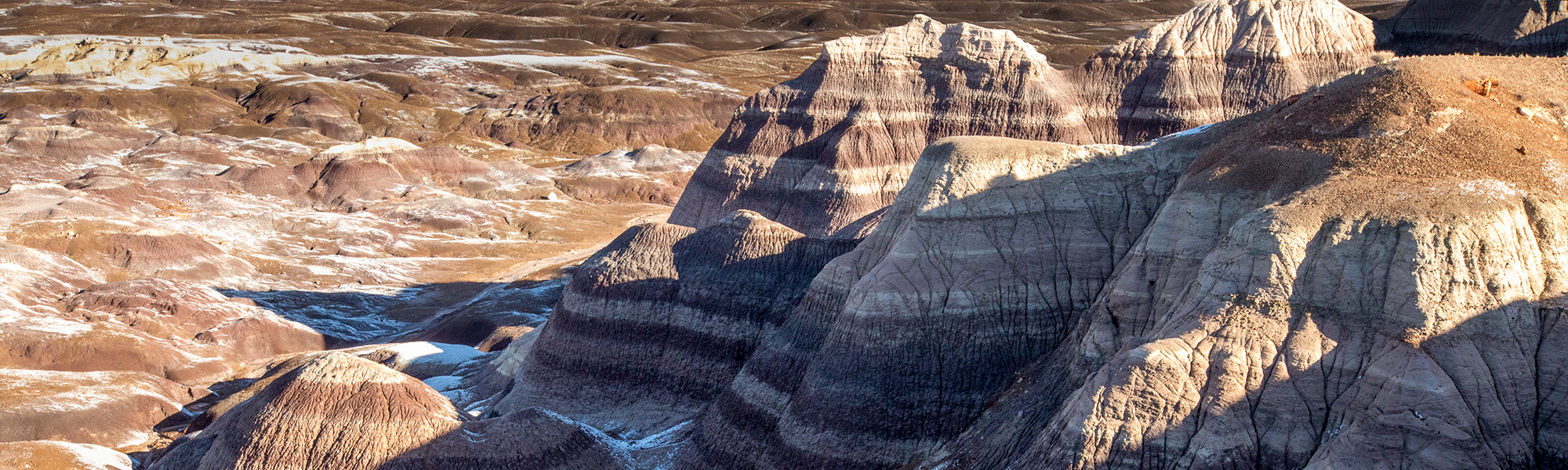
Home to one of the world’s largest and most colorful concentrations of petrified wood, Petrified Forest National Park protects a striking landscape of painted badlands, prehistoric fossils, and remnants of ancient human civilizations. Stretching across the high desert of northeastern Arizona, the park is divided into two major regions—the Painted Desert in the north and the Rainbow Forest in the south—connected by a scenic 28-mile park road. Discover rainbow-hued petrified logs, vast vistas of red, pink, and purple clay hills, and ancestral Puebloan sites that tell the story of over 13,000 years of human history. Quiet and surreal, Petrified Forest is one of the most unique geological experiences in the National Park System.
The northern and southern halves of the park are split by Interstate 40, just 25 miles east of Holbrook, Arizona, making Petrified Forest one of the most accessible parks to visit. The northern entrance off I-40 is more popular and begins the 28-mile Petrified Forest Road through the park. The route heads north towards the Painted Desert, but because that area is mostly wilderness, it quickly turns south to the Rainbow Forest where most of the fossils and attractions are found. The road ends at the southern entrance on Highway 180 leading back to Holbrook. Visitor center services are located at each entrance.

Must-see highlights in Petrified Forest National Park
1
Historic Blue Forest Trail—Blue Mesa is a one-of-a-kind landscape of bluish-gray bentonite hills sculpted into soft domes and ridges and scattered with petrified wood. While the Blue Mesa Loop Trail descends into the badlands from Blue Mesa Scenic Road, opt for the more adventurous Historic Blue Forest Trail off Petrified Forest Road near The Tepees area. Look for a small roadside parking area on the east side of the road. From here a small dirt path will take hikers 1.5 miles back to the Blue Mesa Loop Trail. This less-trafficked route is more scenic and adventurous winding in and around the badlands past some large fossils.

2
Crystal Forest—Even though this loop trail is short and paved, it winds among some of the most brilliantly colored petrified logs, sparkling with quartz crystals. This area highlights the rainbow hues—reds, yellows, purples—found in the park’s fossilized wood.

3
Giant Logs Trail—Located near the southern entrance, the 0.4-mile Giant Logs Trail features some of the park’s largest petrified trees, including “Old Faithful,” a massive log over 10 feet in diameter. The nearby museum offers exhibits on the ancient forest, fossil formation, and Triassic life.
4
Chinde Point—Overlooking the Painted Desert to the north, Chinde Point is a parking area just 2.5 miles from the northern entrance offering panoramic views of pink clay hills and mounds perfect for sunset and sunrise. Just be aware, the park is open 8:00 a.m. to 5:00 p.m. so stop by the visitor center first to obtain a permit allowing you to stay past closing hours.
Wildlife Highlights in Petrified Forest National Park
Wildlife is existant, but not abundant in the park. Most desert animals are active at night and may only be visible on backcountry trails.
- Mammals: Pronghorn, coyotes, jackrabbits, bobcats
- Reptiles: Collared lizards, horned lizards, gopher snakes
- Birds: Ravens, kestrels, meadowlarks, hawks
- Insects: Tarantulas
- Plants: Apache plume, prickly pear, sagebrush, desert wildflowers
Best time to visit Petrified Forest National Park
Because summertime is hot in the Arizona’s desert lands, spring and fall are generally the best times to visit. However, in the absence of snow, winter is an excellent season to explore as you can largely enjoy the park all to yourself.
Note: Petrified Forest is the only park to entirely close down daily, 5:00 p.m. to 8:00 a.m. This helps safeguard the valuable fossils from theft. Do not expect to get enter the park during this time, so plan accordingly. Stargazers and sunset viewers will need to obtain an after-hours permit at the visitor center.
- Spring (March to May): Spring offers mild temperatures ranging from the 50s to 70s°F (10–26°C) ushering blooming desert wildflowers. This is one of the most pleasant seasons for hiking and exploring the badlands.
- Summer (June to August): As expected, summer is hot and sunny, with temperatures often reaching the 80s–100s°F (27–38°C). Afternoon thunderstorms are common during this rainy season. Visitors should plan for heat, sun exposure, and quickly changing weather as storm cells sweep across the land.
- Fall (September to October): Autumn brings the return of comfortable weather in the 60s–80s°F (16–32°C). Visibility for sunrises, sunsets and stargazing are typically best this time of year. Cooler mornings and fewer crowds make this a great time for hiking, photography, and scenic drives.
- Winter (November to March): The park is quiet and chilly in the winter, with daytime temperatures in the 40s–50s°F (4–12°C). The occasional snowfall adds a striking contrast to the colorful badlands. Trails and viewpoints generally remain accessible year-round.
How long should I visit Petrified Forest National Park?
Petrified Forest is not a big park. A single day is enough to explore the park’s main highlights along the scenic drive, but plan at least 6 hours to get a full experience. An overnight trip allows time for stargazing and longer hikes into Blue Mesa or the Painted Desert wilderness. Visitors with 2–3 days can explore backcountry areas, photograph sunrise and sunset over the badlands, and spend more time visiting multiple sites along the park road.
Getting to Petrified Forest National Park
The park sits along Interstate 40 in northeastern Arizona, with entrances at both the north (Painted Desert) and south (Rainbow Forest). The nearest town is Holbrook, about 20 minutes west of the park.
The closest major airports are in Flagstaff, Albuquerque, and Phoenix. Flagstaff Pulliam Airport (FLG), about 95 miles southwest, is the closest airport but has limited flights and connections. Albuquerque International Sunport (ABQ), about 170 miles east, is the most commonly used major airport, with many nonstop flights and good rental car availability. And Phoenix Sky Harbor International Airport (PHX), roughly 230 miles southwest, is a major hub with extensive flight options, but is 4 hours away by car. Only consider this if planning a longer Arizona road trip.
For most travelers, Albuquerque (ABQ) offers the best balance of distance, flight availability, and rental car options, while Flagstaff (FLG) is convenient if you find a good connection.
Where to stay in Petrified Forest National Park
Lodging—There are no hotels inside the park. Nearby options are found in Holbrook, Winslow, and Joseph City, offering motels, small inns, and chain hotels. The misleading Painted Desert Inn is simply an historic landmark offering gifts, food and information. Though labeled an inn, it does not offer overnight accommodations.
Campground—There are no developed campgrounds inside the park, but wilderness backpacking is permitted in the Painted Desert with a free backcountry permit. Nearby towns also offer RV parks and private campgrounds.
When should I book my trip to Petrified Forest National Park?
Spring and fall see the highest visitation, so it’s best to book lodging in Holbrook or Winslow several weeks in advance. Summer and winter generally have more availability unless traveling during holiday periods.
How much should I budget for Petrified Forest National Park?
Petrified Forest is one of the most affordable parks to visit. A day trip to Petrified Forest National Park booked 1 week in advance can cost roughly $100–$500 depending on your required needs. Here is a range of what to expect:
| Roundtrip Airfare to Albuquerque International Sunport (ABQ) | $100–$300 |
| Lodging | $80–$160/night |
| Car Rental | $50–$90/day |
| Meals | $10–$15/meal |
| Entrance Fee | $25/vehicle |
Packing list for Petrified Forest National Park
Each park requires different gear for its unique characteristics. For Petrified Forest National Park, we wouldn’t want to be caught without hiking shoes, hiking poles, rain coat, extra water bottles, a hat, and sunglasses.
Want to learn more? Check out my detailed trip report for a peek into my trip to Petrified Forest.
For more detailed information on Petrified Forest National Park, visit the official park website.

Looking for more?
To view more photos of this park and the rest of America’s 63 national parks, check out my ParkQuest project.