As we paddle back, it’s easy to imagine early settlers and trappers navigating these waters in a similar fashion, establishing highways of commerce and trade. What is recreation for us was survival for them.
September 12–14, 2025
Some of the best trips are often the least planned. As a lesser-known destination, we hardly know what to expect from a trip to Voyageurs National Park when we land late Thursday night in Minneapolis. All we know is to expect water. And lots of it. This is the land of 10,000 lakes after all. After arriving in Minnesota, we rent a car and drive 2 hours north to Duluth to spend the night and break up the 4-hour drive to Voyageurs. The next morning we grab breakfast and continue our journey north. Forecasted rain follows us upstate the entire way. But we don’t let it dampen our spirits. With no expectations, we enjoy exploring the character of an unknown park, rain and all as we pull into the Ash River Visitor Center.
A quick overview of the park tells us our activity will generally revolve around Kabetogama (cab-uh-TOE-guh-muh) Lake. Many of the parks hiking trails and boat tours originate in this area—which is perfect because we intend to camp at Woodenfrog Campground, not very far away. Although this campground is technically outside the park in Woodenfrog State Forest, the campsites are on the shoreline of Kabetogama Lake which lies in the national park. It’s the closest front-country camping Voyageurs has to offer.
We drive the 20 minutes to Woodenfrog and pull up to a first come, first served campsite on the shore of Kabetogama. At this time of year, the scene is incredible. Aspens, birch, and red maples ignite the campground in flames of red and gold. It looks like a fall storybook. A quaint campsite nestled in classic autumn colors perched on the shore of a tranquil lake. Not to mention a buck and doe gracefully grazing under the trees nearby—expectations exceeded already, Voyageurs.

After setting up camp, we return to Ash River to explore the trails. Kabetogama Lake Overlook catches our eye. By the time we park and start hiking the clouds start to congregate in clumps, exposing moments of sun and blue sky overhead. Only a short walk from the car, the overlook gives a window through red and white pines of the islands of Kabetogama. Sun pockets illuminate patches of water and forest in the distance, easily making this one of the most scenic views of the trip.

Hungry for a little more than 0.13 miles of hiking, we find the nearby Blind Ash Bay Trail, a 3-mile lollipop loop to a hidden cove of Kabetogama. The trail skirts us above the shoreline under a dense canopy of pine and birch. Ferns in their final moments of fall color turn auburn all around us. Descending down to Blind Ash Bay, we stop to take in the sights and sounds of Voyageurs. A loon cries nearby. Water laps at our feet. Trees across the water sway in the breeze. A faint motor boat cruises in the distance. It’s a short hike, but we easily spend 3 hours here.

Back in the car, we make one more reconnaissance stop on our way back to camp. We hear Beaver Pond Overlook is an excellent spot for wildlife sightings. According to our sources, large mammals and water fowl frequent the area—and of course the ever-curious beavers of Beaver Pond. Again a short hike takes us up some steps to a perch high above the pond. The bird’s eye view of the scene is great for spotting animals. . . if you remember to bring your binoculars. Aside from birds flitting to and fro in the trees, we are a little disappointed at the experience. Far above the water, we cannot see the wildlife if there is any to be found. At long last, a lone beaver pops up among the reeds for a short time only to duck under the water again. That’s the most we see. Maybe our luck will be better in the morning.
The next day, we wake before the sun to a gray cloudy sky. Hoping to catch some early-morning wildlife at Beaver Pond, we hop in the car and drive to the overlook. Again, silent. Nothing stirs in the still waters below. We’re about to leave the viewpoint when we notice a side trail matted down by foot traffic. Curious to follow we find ourselves down at the water’s edge in a perfect position to spot animals. And as if on cue, a furry head pops up from the water to investigate our arrival.

We spend a good amount of time watching beavers cruise around the pond through the reeds, busy about their work, occasionally making loud splashes with their tails as they dive deep. Thrilled to see wildlife up close we make our way back to camp to eat a quick breakfast before our boat tour at 10 a.m.
Meeting at Kabetogama Lake Visitor Center, we board our boat with 27 other passengers and set sail across the water to Ellsworth Rock Gardens. Not exactly sure what to expect, we disembark on what was once a private homestead in the 1940s. Here, Jack Ellsworth passed his time erecting abstract rock sculptures with nothing but his own manpower. A bit eccentric, but oddly fascinating, the rock garden winds up and around a grassy knoll. We are allowed about 40 minutes of strolling before we board the ship for the rest of the boat tour.

Taking the long, scenic route back to Kabetogama Visitor Center, the captain weaves through inlets and channels in what is locally known as “Eagle Alley”. Here, the ranger points out bald eagles nesting and perched in white pines high above the water. This late in the season, the birds are nearly ready to migrate south for the winter. Thankfully a few stragglers give us a show in the high canopy of the forest.

Back at Kabetogama Visitor Center, we inhale a quick lunch and drive over to Rainy Lake on the northern side of the park, a good 45 minutes away, to rent a canoe and take to the water ourselves. Meeting the rental service at the Rainy Lake Visitor Center, we hop in our vessel and paddle out to Kabetogama Peninsula, roughly half a mile away. Following the coast we find a dock for Black Bay Beaver Pond Hiking Trails and stop for a little bit spotting more eagles in the tall trees. Given yesterday’s forecast, we are grateful to be on the lake in such warm, sunny weather.

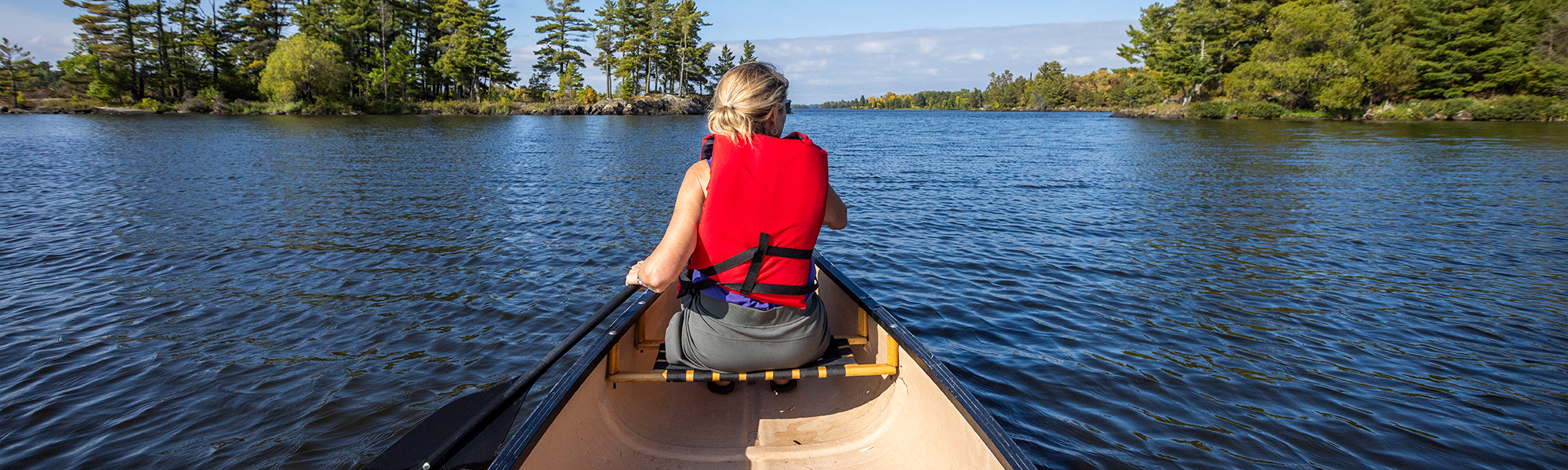
Traveling up coast as far as we dare before our 7 p.m. return time, we turn at Big American Island float back to the Rain Lake Visitor Center. On the way back, we pull over at a nearby tiny island, only about 100 feet long. It’s fun to pull ashore on our own private island all to ourselves. The sun turns golden and begins to set, cueing our return to the dock. As we paddle back, it’s easy to imagine early settlers and trappers navigating these waters in a similar fashion, establishing highways of commerce and trade. What is recreation for us was survival for them.

By recommendation, we stop for dinner at the Rocky Ledge, an old salty restaurant full of local color on our drive back to camp. That night, the clouds clear and stars emerge in a brilliant display. But that’s not why we stay up. Rumor has it, the northern lights are visible year-round here in Voyageurs. We just need high solar activity and clear skies. Staying up until midnight, we shoot some night photography hoping to catch the colorful skies. While a little aurora is visible in the photos, we cannot see it with our eyes, so we turn in for our last night in Voyageurs.

The next morning we awaken to a brilliant peachy pink sky. Soon, morning haze from lake humidity catches the sun’s rays bathing everything in a golden hue. We pack up camp under a tent of golden leaves and golden skies. We linger as long as possible to soak in the last minutes of Voyageurs National Park. But with a 4-hour drive ahead of us, we hit the road. The drive back is fulfilling as we reminisce about our lake adventures. It’s always good leaving a park wishing we could spend more time. It just gives us more excuse to return again for more.


Looking for more?
To view more photos of this park and the rest of America’s 63 national parks, check out my ParkQuest project.