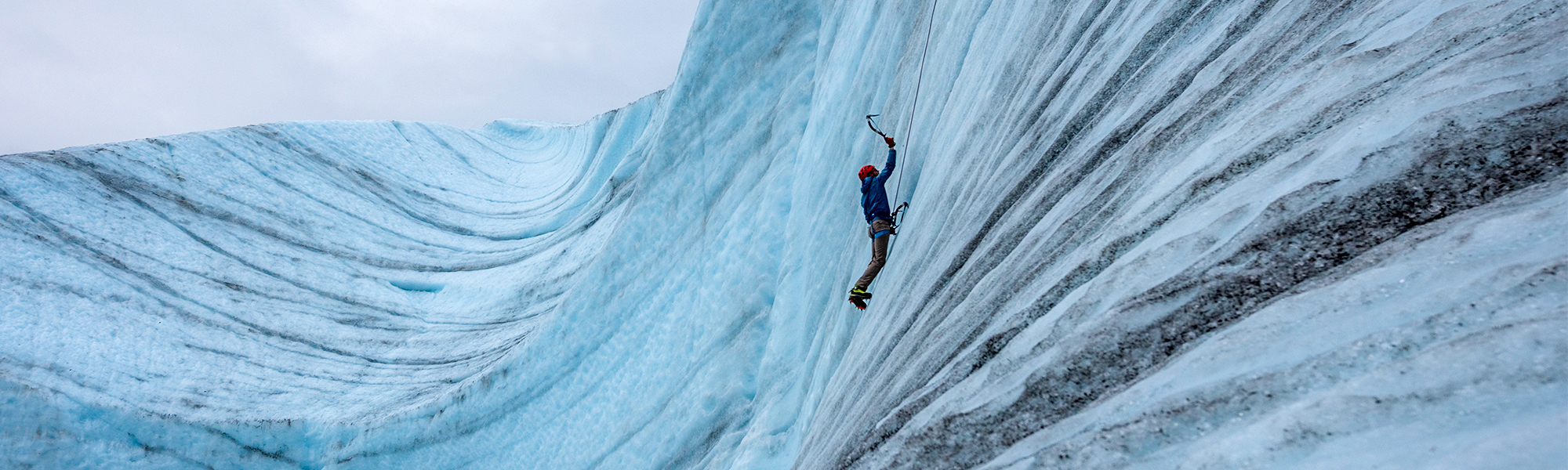
I sit for a moment in the midst of the moulin soaking in the surreal environment. The rush of falling water echoes in the blue world below. I feel isolated and disconnected from the outside world, swallowed by the glacier.
July 30–August 3, 2025
After landing back in Anchorage at Merrill Field Airport from our dreamy stay in Lake Clark National Park, we shuttle to Merrill Field Inn a half-mile away. It’s already 8:00 p.m. so we reorganize our luggage and turn in for the night. The next morning comes early as we shuttle down to Ted Stevens Anchorage International Airport to pick up our rental car. Because our destination McCarthy, the hub of Wrangell-St. Elias, lies 60 miles in the heart of the park on the McCarthy Road. Because of the reputation of this gravel road, only select companies will allow their rental cars to access McCarthy. Thankfully, we anticipated this early on and booked a reservation with Alaska 4×4 Rentals.
At the airport, we pick up our Chevy Traverse and set sail for McCarthy. The scenery is gorgeous as we drive along Alaska Highway 1 through the Chugach Mountains. Low clouds nestle into the craggy peaks as hints of distant glaciers peak through canyons beyond. Eventually we make it to Chitina, the gateway to Wrangell-St. Elias National Park, and begin the infamous long dirt road to McCarthy. We’ve heard enough warnings from blogs and friends about this road so we take it extra slow as we roll onto the gravel roadway. We cross the Copper River and plunge into the Alaskan wilderness.

So far, the road is pretty tame. Sure, there are warped sections with lots of dips and bumps, but nothing a low-clearance sedan can’t handle. Feeling confident, we press on taking note of the landmarks along the way: the Kuskulana Bridge, the Gilahina Trestle, Long Lake, etc. About 53 miles in, we come across a charming little pond with a family of trumpeter swans feeding among the water. The evening sun breaks through the clouds at just the right time, illuminating the birds a brilliant white against the deep mountain backdrop.

About 7 more miles to go. It’s 8:30 p.m. and still bright out. A mile from the end of the road we turn down a side street and make our way to our host’s home, a humble mountain cabin perched on a hill with a stunning panoramic view. I met our hosts through my day job almost a year ago. When they learned of my quest to visit all 63 parks, they were kind enough to offer their guest rooms for my parents and me. Settling in for the night, we lay out plans for tomorrow. I am scheduled for an ice climbing tour of Root Glacier at 8:30 a.m. so my parents plan to walk the historic town of Kennecott.
The sun rises early in Alaska summertime, but I do not. It’s 7 a.m. and the sun has already been up for several hours. Excited, but still groggy from a long day yesterday, we all drive down to the end of McCarthy Road. Cars are not permitted across the Kennicott River so I am dropped off to cross the footbridge on my own. I mile away, I walk into the little town of McCarthy and head for Ma Johnson’s hotel, where I am to meet my guide service for ice climbing. Soon, a shuttle van from St. Elias Alpine Guides (SEAG) rolls up to take me up to Kennecott.

In Kennecott, I locate the SEAG building and find my guide, Charlie. He fits me and two other clients for climbing boots, crampons, and a harness. I grab a spare pare of loaner gloves and sunglasses and follow Charlie to Root Glacier. The hike is 2.5 miles one way so the four of us kill the time by introducing ourselves and getting to know each other. Nearing mile 2, we turn downhill and see the glacier for the first time. An electric blue slab of ice sliding down the valley greets us as we descend to the foot of Root Glacier. Here we strap on our crampons, tighten our harnesses, and follow Charlie out onto the ice. While we trek to our first pitch, Charlie instructs us in the basics of ice climbing. Position heels out, toes in. Keep a wide stance. Align our ice tools together above our head. Rely on legs, not arms and ascend the ice like a ladder. Seems easy enough.

After the other two men rope up for a climb, it’s my turn. I step up to the ice wall and start climbing. I strangely feel like Spider-man, crawling up a sheer wall on all fours. Charlie belays me from below. Once I get a hang for the rhythm, it’s actually quite easy. I reach the top, survey the view and repel down. Exhilarating. When can I go again? After we each climb twice, Charlie decides to up the ante. He packs up the ropes and we follow him further down the glacier to a moulin. If you’ve never seen a moulin, think of a giant megaphone pointing upward. Essentially, it is a hole carved by falling water into an abyss of unknown depth. The sides of the moulin gradually get steeper and steeper, exponentially dropping into darkness. Charlie is careful to keep us away from the moulin until the ropes are set. This time I am first up. I tie into the ropes and step over the edge into the abyss. A small waterfall plunges into the crevasse across from me. I look down. The terrain down here reminds me of Antelope Canyon, only blue.
Fearing my inability to ascend the moulin, I signal Charlie to stop the repel. I sit for a moment in the midst of the moulin soaking in the surreal environment. The rush of falling water echoes in the blue world below. I feel isolated and disconnected from the outside world, swallowed by the glacier. Soon I begin the climb. I kick in my toes and stand up. Little by little I work myself out of the blue hole reunited with the daylight above. I can’t believe I just did that!

The other two climbers have their turn, then we’re each offered the chance to descend once more. This time, I challenge myself to drop lower than last time. The further down the moulin, the harder the ice becomes. Compression and temperature keeps lower layers of ice slick and hard. Not like the aerated crunchy ice atop the glacier. I drop below my mark last time and find a depth I’m comfortable with. Again, the rush of water around me matches the rush of adrenaline in me. I kick my toe into the ice. It glances off. Not so easy as above, I guess. I take another stab. This time I glance to the right. I dig my ice tool above my head to brace myself from swinging on the rope. I kick my toe. This time I lodge it in the ice. Now for the other foot. I kick hard. With this foot in too, I start lifting my weight off the rope. . . and slip. The harness catches me and I try again. After several unsuccessful attempts I sit to regain my strength. One last time and I’ll call for help. Toe in, toe in, stand up. And slip. Again, no luck. The ice at my feet is too tough for my inexperience, while the ice above my head is too fragile to pull myself up. Discouraged, I yell “rescue” up to Charlie. In cases of “rescue”, the belayer will unhook from the rope and construct a pulley system to hoist the climber out of the pitch. Because the climber is not on belay, under no circumstances should they resume climbing. They must remain dead weight from now on. Not sure if he heard me over the roar of water, I wait. A couple minutes roll by. Soon I feel the familiar tug on the rope as I am lifted inch by inch from the moulin. A humbling experience, no doubt. But all the same, I’m grateful to have challenged myself in a sport I’ve never attempted before.
Nearing the end of the day, we pack up and hike back to Kennecott before dinnertime. The shuttle van drops me off at the footbridge and I hop in the rental car back to the cabin. We recount the day’s adventures over a plate of homemade tacos. It still feels early, but already it’s 8:30 p.m. Our hosts turn in for the day and so do we. The next day, we wake up slow, eat a wonderful breakfast of eggs and sausage, graciously prepared by our host. Since we are headed for the Kennecott Mill Tour this morning, she and her husband offer us their personal ATVs for transportation across the footbridge. Blown away by their kindness we take them up on the offer.

Buzzing up to Kennecott, we check in for the Mill Tour and follow our guide up a trail to the top of the 14-story mill. Starting at the top and winding down through the historic structure, she recounts the golden years of this (literally) groundbreaking operation. Over its lifespan the Mill extracted $200 million of copper ore. That equivalent to several billion dollars today. We relive the process from crushing to sorting to extracting to bagging the copper, ending at ground level where the train once hauled it away to ports in Cordova for sale. For $34, this tour was absolutely worth it. The Kennecott Mines dominate the landscape so it is valuable to understand the history of the park.

While in the mill, a weather system rolled in, so we pack up and zip back down the mountain on the ATVs stopping by Wrangell Mountain Air in McCarthy to book a flightseeing tour tomorrow. We are told that is the best way to see the park. It’s a bit of a risk since the flight service is wary of predictions. In a moment of spontaneity, we book the flight for 10 a.m. and hop back on our ATVs. Caught in a deluge we return to the cabin soaked and chilled. Changing into dry clothes we sit down to another scrumptuous dinner of Alaskan salmon and potatoes from the garden. We take the evening slow and turn in for the night, hoping beyond hope the weather clears tomorrow. While the storm has subsided for the night, the clouds linger. We are still unable to see any of the high elevation mountains. I am itching to see Mount Blackburn as it is taller than any mountain I have back home in Colorado. All we can do is wait and see.
It’s Saturday morning and the first thing I do is run to the window to check the clouds. It appears everything has cleared out! After three days of low clouds, a cheery blue sky greets us. Some small clouds cling to a few ridgelines and peaks, but our hosts are hopeful they will burn off by noon. We eat a quick breakfast and roll down to Wrangell Mountain Air. After some orientation we climb in a cessna with our pilot, Orin, and take off on our 50-minute tour.

The views are incredible. For the first time, we are able to grasp just how massive this park is. Orin steers us over the Nizina River to mile high cliffs. Then we soar over Nizina Glacier in a stead climb. At altitude, we cross in front of Regal Mountain and the Stairway Icefall, the world’s tallest icefall—bigger than the Khumbu Icefall on Everest. Finally we shore up tight with Mount Blackburn, whose lower flanks are shrouded in clouds, but peak rises above. While it all appears so massive, it’s almost difficult to grasp the scale of this park. Everything looks like a diorama from so high. And yet, I know we are looking at nearly 15,000 feet of prominence between McCarthy and Blackburn. Turning us back home, Orin flies us over the Kennecott Mill. What seemed to dominate the landscape from below now looks like an infinitesimal speck on the map.

Back on the ground we marvel at what we just saw and praise Orin for his excellent tour. He thanks us and we go on our way. With a day of sun ahead of us, we head back up to Kennecott to take my parents out to Root Glacier. I’m excited as the sunny weather on a glacier will create a new experience for me as well. We hike the 2.5 miles and don microspikes that we packed from home. Stepping onto the glacier we enter a world of ice and snow. I retrace my steps from the previous day’s ice climb and relive the excitement with my parents. This time I can see Blackburn and Stairway Icefall clearly in the distance, creating a completely different experience than before. We easily spend almost two hours on Root Glacier exploring nooks and crannies. But with clouds rolling in from overtop Blackburn, we decide to return home.


On the way back from Kennecott, we pick up some hikers and drive them to their lodging before the rain hits. After dropping them off, we are once again caught in the rain, drenched by an afternoon storm on the ATVs. At this point, the day was so delightful, I welcome the adventure of riding in the rain. Something about it just feels good. Back at the cabin we eat a meal of homemade pizza and fresh salad from the garden. I’m learning people in Alaska eat well. The day concludes with some backcountry sheep-hunting stories from our hosts—complete with near death experiences, thrilling chases, and lessons learned. Grateful for our time in Wrangell, it is sad to realize our last night has come. We head to bed and prepare for the next day.
In the morning, we attend church with our hosts. Because they live in McCarthy year-round, we are able to meet the folks they call family and friends. After a stellar sermon streamed in from afar, we all partake in a potluck lunch, Baptist-style—leftover pizza from last night, lasagna from down the street, bean soup from a visiting family in Palmer. Brownies are our contribution. Kids run around outside barefoot in the sun, picking raspberries from the garden. This is America at its finest. This is the National Park experience I am looking for.
2:00 p.m. rolls around and it’s time for us to leave. We are spending the night in Palmer so we have a long drive ahead of us. Hugs and handshakes make their rounds as we promise to return in the future and share more of Wrangell-St. Elias together. The long drive back down McCarthy Road cements the fond memories in our minds. Pulling into Palmer at 9:00 p.m. we bed down for the night and wake up early for an 8:00 a.m. flight out of Anchorage. It feels like a lifetime of adventure since we were last home. Lake Clark, Katmai, and Wrangell did not disappoint. Alaska gave us her best, and it only leaves us hungry for more.


Looking for more?
To view more photos of this park and the rest of America’s 63 national parks, check out my ParkQuest project.