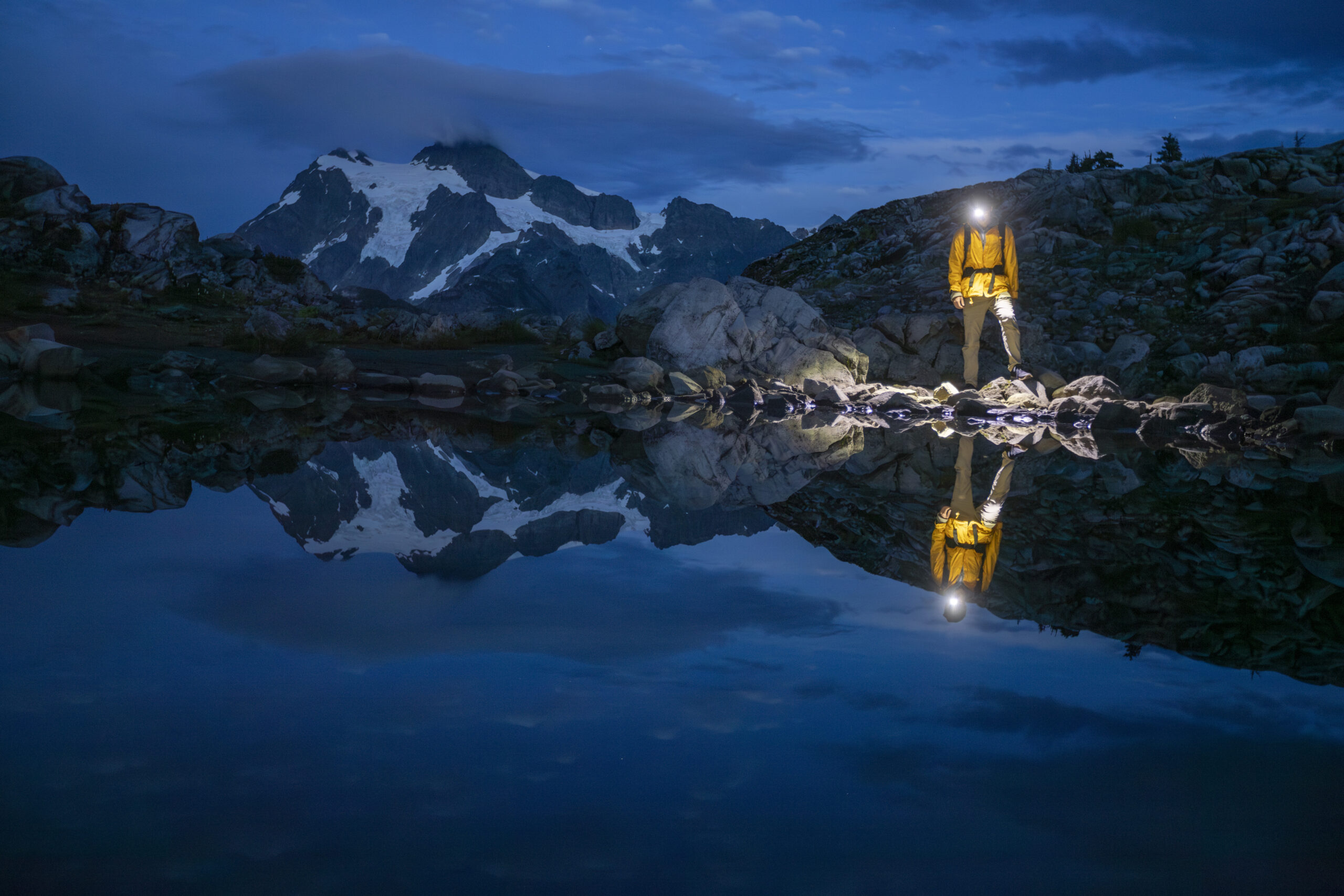
After trudging through what feels like a half mile of water, we pause and let the ripples die down. And there it is. With our eyes still adjusting, we see the Milky Way not just above us, but beneath us too. We’re suspended in space with stars all around, creating one of the most exhilarating park experiences I have yet to top.
January 5–8, 2020
It’s true every park leaves a lasting impression after you visit, but little do I just how much Death Valley will change the course of my life in the days ahead. As a Christmas present to my brother, I had set up a trip for the two of us to explore Death Valley for a couple days. So early in the new year, we board our red-eye flight to Las Vegas, pick up our rental car and crash at a motel in Beatty, Nevada, just 8 miles from the park boundary.
Eager to explore, we sleep only a couple hours before waking up early and driving into the park to catch the first rays of sunlight. Our destination is Zabriskie point, an hour’s drive into the park so we leave at 5:30 a.m. to give us plenty of time. The road gives me tunnel vision as the pitch-black desert silently glides past us. Stars are out in full force as the eastern sky just starts to give way to dawn.
We pull into the Zabriskie Point parking lot as blue hour is in full swing. Several other early-morning hikers join us. At the overlook, Golden Canyon sprawls out before us giving way to the desert valley floor and the Pinamint Range beyond. Telescope Peak, the park’s tallest point is dusted in snow. I’m already in love. The colors are so harmonious in all the nooks and crannies. Manly Beacon, the iconic pinnacle of Death Valley stands watch over Golden Canyon awaiting the first glint of dawn. In the background the Pinamint Mountains begin to glow a soft purple, then warm pink, then iron red before bursting into the golden hues of sunlight. We watch in awe as the curtain of light creeps down the range and makes its way towards us.

Soon, Manly Beacon catches the sunlight and true to its name illuminates like a lighthouse before the rest of the canyon. Snapping pictures like crazy, I run around the overlook basking in the different perspectives and compositions cast by the newly formed light and shadow. After enjoying the view for a good while, we make plans to hike down into the canyon for the morning. Starting on Gower Gulch Trail, we immerse ourselves in the mustard-colored canyon, weaving our way in and out of badland crevices.
Keeping right, we find ourselves directly below Manly Beacon. The fin of rock is striated with layers of mineral rich rock. Here we turn down Golden Canyon Trail, the set location for Star Wars: A New Hope. It all looks so familiar from the movie. About a mile later we pop out along the desert floor at the Golden Canyon Trailhead along Badwater Road and parallel the road on a connector trail to complete the loop back to the car.

It’s mid-morning in January and already the temperature is pushing 80ºF. For a couple of Colorado residents, this is our limit. Hot and dusty from the morning hike, we turn to the Furnace Creek Visitor Center next to escape the coming heat. After some time familiarizing ourselves with the park’s attractions, we make plans to scout out the scenic roads now and return later in the day for a sunset hike when things cool off more.
Back in Beatty, we load up on food, water and sleep in the afternoon heat. As 4 p.m. rolls around we head back into the park, this time making our way to Stovepipe Wells and the nearby Mesquite Flat Sand Dunes. With a winter sunset at 6:00 p.m. the westering sun is already casting long shadows on the dunes. We toss a frisbee around as we wait for the dusk colors to set in. Desert pinks and purples emerge from the shadows as the sun dips below the Pinamint Mountains. I’ve never seen so many colors in a desert before. Enjoying the cool temperatures we linger a bit longer until I can no longer see the frisbee whizzing by my head. That’s our signal to turn in for the night. Watching the star forecast, we make plans to return here in the early, early morning to try my hand at astrophotography as night turns to morning.

Turns out, I still have a lot to learn about star photography. None of my photos work as intended. But with dawn an hour away, we hunker down in the car for a quick nap and wake in time for sunrise. Because our flight home leaves tomorrow, this is our last day in the park. We want to make the most of it. So after a quick bite of breakfast on the dunes we hit the road for a smorgasbord tour of Death Valley.
With most of the attractions past Furnace Creek, we make our way south, stopping first at Red Cathedral, an iron-red rock face with columns and ridges resembling that of a gothic church. Back in the car, we venture on to Badwater Basin. Excited to check the “lowest point in America” off our list, we hop out of the car and trek out onto the salt flat. High up on a cliff face behind us, a white marker denotes actual sea level. It’s surreal to imagine an ocean of water on top of us where we stand now.
At first, we hear the salt crunch under our feet, but as we range further and further out the sound turns to squish and then splash as a skim of water blankets the entire flat before us. What I had thought was a mirage was indeed water. Rainwater from distant storms has collected here in the valley’s low point sitting stagnant and perfectly still, like a mirror. My brother and I race on splashing through the salty ankle-deep water.
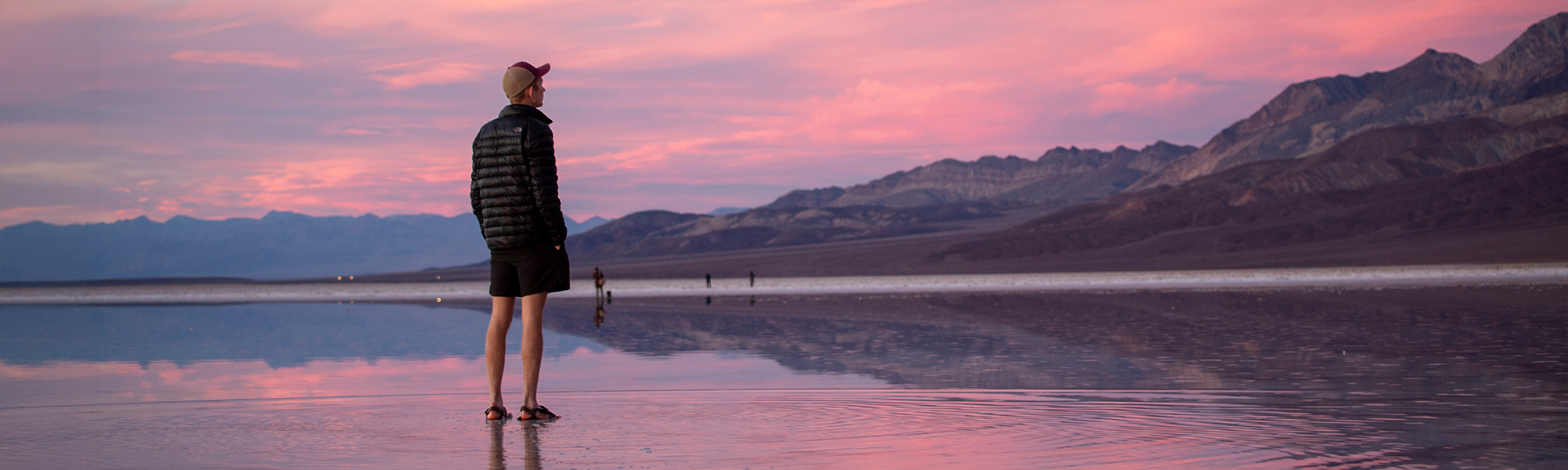
Far enough out, we lose sight of dry ground. Standing real still, we wait for the ripples to die down and that’s when the surrealism begins. Under completely calm conditions, it appears as if we are standing on an endless mirror surrounded by mountains both up and down. Ecstatic at the phenomenon, we look each other and have the same thought: this scene would be epic at sunset!

Returning to the car, we jump in and continue our tour of Death Valley. A layer of cloud moves in casting some relief from the sun so we stock up on water and risk an afternoon hike to Natural Bridge, a rock archway once carved by water erosion. The trail is short and the hike is surprisingly cooler than anticipated as we work our way up the half-mile canyon trail to the rock.
With more time to kill before sunset, we hit a few more destinations, like Devil’s Golf Course and Artists Drive. Devil’s Golf Course is a field of jagged salt formations said to be so rough only the devil could play golf on this surface. And that would seem to be accurate. The salt crust is so sharp we are at risk of cutting ourselves. Across the road from Devils Golf Course is Artists Drive, a scenic one-way road up to Artists Palette, a deposit of mineral rich rocks in all shades of blue, pink, yellow and green. It’s almost as if someone snapped a giant tray of chalk pastels and left the bits behind.

At this point, the sun is about to set. We’re a little nervous though. The clouds are lingering and could obstruct the sun. But taking our chances, we still return to Badwater Basin and walk out on the water. Sure enough our dreams come true—more than we could’ve hoped for, too. Instead of obstructing the sunset, the clouds actually intensify the sunset as they burn pink and orange in the fading sun. I can hardly believe my eyes. I’ve never seen anything like it. We are floating in a world of cotton candy clouds mirrored above and below us. In every direction, abstract textures and shapes fill the scene in a dramatic display of light and color. Okay, Death Valley, we see you.
I wildly snap as many pictures as I can before the fleeting moment is over. As the sun disappears, the sky turns pale and dark. The moon shines brightly overhead as we slow walk back to the car. But a thought keeps nagging at me. What would this look like at night with just stars? We have to leave early the next morning for the airport, but we both decide we have to find out. So booking it back to the hotel, we pack up and sleep for only a couple hours.

Around 2 a.m. we rise groggy but determined to drive back to Badwater Basin. By now the moon has set and a brilliant display of stars shines overhead. This is gonna be good. We’re the only ones at the parking lot. Grabbing my camera and tripod, we set out into the basin. It’s disorientating to walk out in utter darkness and not have a reference point to track. After trudging through what feels like a half mile of water, we pause and let the ripples die down. And there it is. With our eyes still adjusting, we see the Milky Way not just above us, but beneath us too. We’re suspended in space with stars all around, creating one of the most exhilarating park experiences I have yet to top. And I doubt I ever could.
What a way to end a trip. Watching our time, we head back to the car. As with most park visits, the 3-hour car ride to the airport is a welcome time to pause and transition from the thrills of park travel back to normal life. We reflect on everything we just witnessed: the sunrise on Manly Beacon, the soft colors of Mesquite Flat Sand Dunes, all the way to a rapturous sunset on Badwater Basin. The creativity of God to craft nature in such bizarre and stunning forms and colors blows us away. Little do I know that these experiences in Death Valley will fuel an obsession for the hidden beauty of all 63 national parks in the years to come.

Looking for more?
To view more photos of this park and the rest of America’s 63 national parks, check out my ParkQuest project.