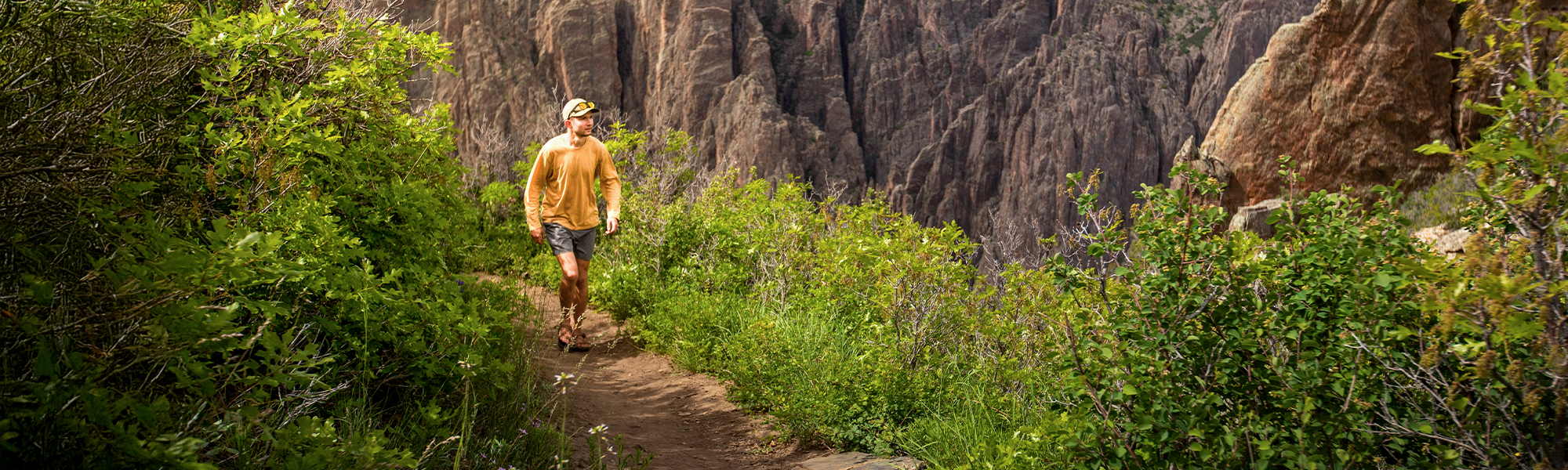
A short cliffside trail takes me out to a breathtaking view of the canyon and a giant 2,250-foot tall rock face riddled with massive streaks of pegmatite rock. It almost looks like a perfect slab of marbled steak waiting to be seared by the sun. It’s an impressive sight to say the least.
June 10–11, 2023
After an awe-inspiring stay at Great Sand Dunes the night before, I pack up in the morning and hit the road west towards Black Canyon of the Gunnison National Park. Arriving mid-morning at South Rim Campground, I locate my campsite and check in before heading out on South Rim Road. Having just commuted through endless desert shrublands for the past hour, I’m not sure what to expect. I’ve seen pictures of the canyon before, but I’m confused how a dusty dry region can produce such lush canyon photos.
But it all makes sense as I crest a hill and get my first look of the canyon. The brown dirty sagebrush of western Colorado suddenly rises and gives way to a massive rugged scar in the earth. This canyon is so well hidden, you would not know it exists from just outside the park. Seemingly out of nowhere, the flat land suddenly plunges into a nearly 2,000-foot gorge of volcanic wrought rock. Few park entrances capture my imagination like this one.
I’m quick to drive the length of the 12-mile road to scout out the extent of the park’s accessibility. At road’s end, I turn around and make a beeline to the iconic Painted Wall Overlook. A short cliffside trail takes me out to a breathtaking view of the canyon and a giant 2,250-foot tall rock face riddled with massive streaks of pegmatite rock. It almost looks like a perfect slab of marbled steak waiting to be seared by the sun. It’s an impressive sight to say the least.

At this point, I’m eager to get moving and find a longer more immersive trail for the afternoon. Near the South Rim Visitor Center, I hop on to Oak Flat Loop, a scenic 2-mile loop diving 400 feet down the canyon before returning back. Merging on to Uplands Trail to extend my hike, I cross the road and find a leisurely stroll through gambel oak and sage brush. The afternoon sun drenches the landscape in a golden tint.

With sunset closing in, I return to the car and drive back down the road to Dragon Point to watch the sun dip below the horizon of the western canyon walls. I make it just in time as a few scattered clouds cast dramatic sun beams over the marbled cliffs. This is easily one of Colorado’s best sunsets. Blue hour sets in and I return to camp, stopping at Tomichi Point along the way to snag a few last-light photos over the gaping canyon mouth.

Sunrise comes early so I hit the hay and set my alarm for 4:00 a.m. With just enough time, I crawl in the car and drive back to Painted Wall Overlook, hoping to catch first light on the rock face. Sure enough, like heated iron, the rock begins to glow pink and orange in the new day. I take my fill of sunrise photos in the photogenic light before moving on. I want to make sure I am in line at the visitor center to secure a permit for the inner canyon trails.

It’s 7:30 a.m. now and I’m not the only one with this idea. Several groups of hikers circle the front door waiting for permits to open at 8:00 a.m. Soon enough a ranger lets us in and takes down names for permits. Conveniently, when he reaches me at the end of the line, there is only one slot left for the Gunnison Route Trail. With a sigh of relief I take the last permit and join the others at a short ranger training to orient ourselves with the nature of this steep loose trail. Though cables are secured along the way for stability, it is easy to twist an ankle, take a spill, or at the very least send a mini rockslide on hikers below, so we must learn the safety measures required for hiking the route.
Ready and eager to hit the trail, I fill up my camelback and plunge down Gunnison Route Trail. At first, the trail switchbacks at a gentle slope lulling me into a false sense of security before plummeting sharply down the canyon. Trees are all around, so I never feel unsafe, just unstable. If I tumble there is plenty to grab on to and I cannot fall more than a few feet at a time. As you would expect, the descent is quick—maybe 40 minutes tops. Reaching the bottom, I am immediately met with the raging Gunnison River. It is so neat to finally witness this waterway up close after viewing it from the rim all day yesterday.

Towers of rock jut up at acute angles, proving this park to be the narrowest and steepest of canyons. Everything is so close, the entire corridor almost feels claustrophobic. At the canyon floor, the trail disappears and drops hikers onto a small riverfront bank with primitive unmaintained trails leading both left and right. I follow them as far as I can, but they soon disperse or cliff out along the river side. With a limited quota of hikers, it’s quiet down here . . . and peaceful too. The roar of the river drowns out everything in a rather calming white noise. I take 15 minutes to rest and enjoy the solitude before gearing myself up for the trek back.
What took 40 minutes to come down, is now taking twice as long to scramble up—and “scramble” is an appropriate word. The cables provide convenient handholds to hoist myself up the loose scree. Careful of other hikers, I eventually make my way back to the rim ecstatic at finishing one of Black Canyon’s iconic hikes.
With some time to kill before the journey home, I pull out my oil paints at Pulpit Rock Overlook to capture the scene in a more patient manner than I’m used to with a camera. The late morning turns to afternoon and it’s time for me to pack up. Pleased with the painting I stow it away safely in the car and start the 5 hour drive home. Black Canyon of the Gunnison may just have stolen my heart. While Rocky Mountain National Park gets all the attention, Black Canyon left me impressed and grateful for the hidden gems of Colorado, like I’m the first one to discover a secret that no one knows yet.


Looking for more?
To view more photos of this park and the rest of America’s 63 national parks, check out my Park Portraits project.