The scene is straight out of a travel brochure. Pristine blue skies, lush tropical vegetation hanging on the rocky shoreline, a salty spray in the air.
September 23–25, 2025
I remember when Hawai’i felt far. But today, I land in Hawai’i and am still are only halfway to American Samoa. With a 24-hour layover, I crash at a friend’s house on Oahu, dipping my toes into that warm tropical island life. My friend and I spend the time walking the beach and hiking the mountains of Oahu’s coast. It’s a wonder this is not a national park.
That afternoon, I board a sparse flight to Pago Pago, the capitol city of American Samoa. Another 5.5 hours and I’ll step foot on land the furthest from home I’ve ever been. A heavy rainstorm greets us on the tarmac as we deplane and slosh to the one-gate terminal. I collect my belongings, find the shuttle to Tradewinds Hotel, and check in for my stay. Not knowing what to expect, the hotel is surprisingly luxurious. Clean, air-conditioned rooms and a soft bed is all I need.
The next morning, I wake up, grab breakfast, and pick up my rental car from the hotel staff. The car has a couple dings and needs an oil change, but other than that is in great shape. As last night’s storm gives way to sunny skies, my first thought is to get into the park and take advantage of this good weather.
Driving through the tight, congested streets of Tutuila Island, I make my way to the visitor center for a quick lay of the land. The ranger walks me through the various trails, attractions, and beaches to visit. Casually mentioning this is my 63rd and final park to visit, she excitedly prints out a certificate commemorating the moment and snaps a photo for social media.
Feeling like royalty, I leave the visitor center and head straight to what I think is the iconic destination for American Samoa, Pola Island Trail, just past the village of Vatia. It’s 9 a.m. and already hot and muggy. The warm equatorial sun soaks my skin, while the ocean spray keeps things cool. Parking at the end of Route 006, I follow a dirt road in the jungle along the coast and pop out on a rocky beach. The towering cliffs of Pola Island meet the churning ocean right before me. The scene is straight out of a travel brochure. Pristine blue skies, lush tropical vegetation hanging on the rocky shoreline, a salty spray in the air.


The forecast had predicted rain the entire week, so I’m happy and content with this. My expectations are already exceeded. Everything else is a bonus at this point.
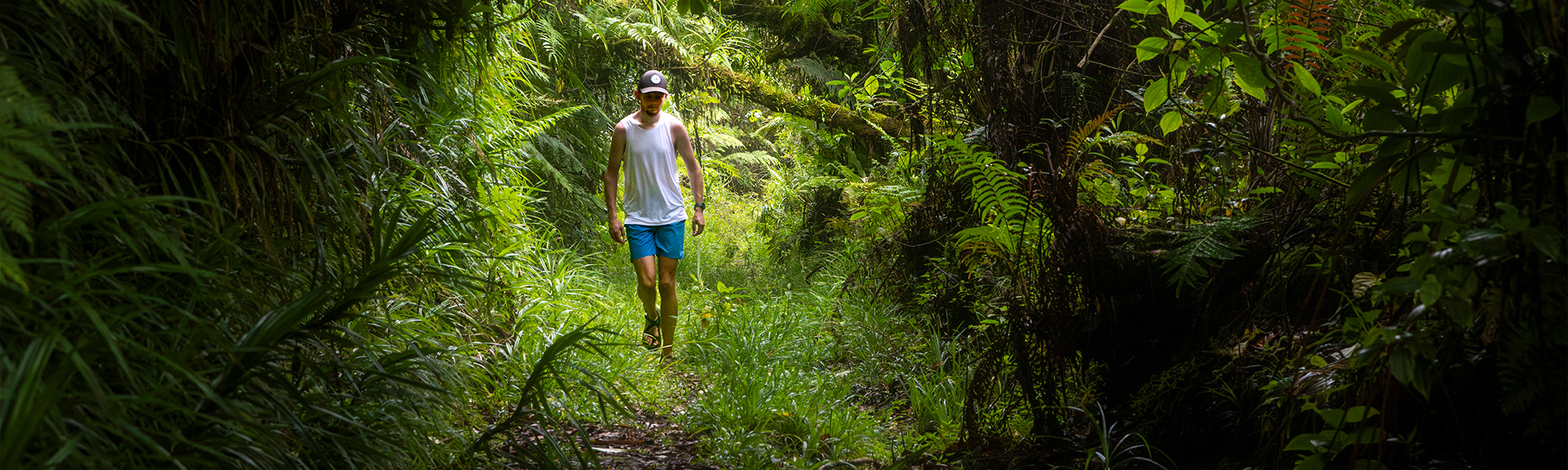
Back in the car, I drive a little way back down Route 006 and spot a sign on the right for Tuafanua Trail. Parking here, I poke around in the brush looking for the start of the trail. Finding an overgrown unmaintained path, I follow it like a loose thread, eventually climbing switchbacks up the back of a nearby ridge. The jungle trail is dense and fun, full of frogs, lizards, and hermit crabs crossing the path. Reaching a saddle in the route, I descend down the other side towards a western view of Pola Island. The trail becomes adventurous and involved as I climb down ladders and ropes. Unsure how far this trail goes, I pick a turnaround point in the slick footing and return to the car, unaware I was close to the end of the trail on the western beach. . . oh well. Regrets make good excuses for revisiting certain parks.

Driving back through Vatia, I make an impromptu stop at the pulloff for Lower Sauma Ridge Trail. From the roadside, a picturesque view of Pola Island is perfectly framed in the trees. Finding a stone path, I wind down a quarter of a mile to the water’s edge. Panormaic views of Vatia Bay and Pola Island open up before me. Along the rocky coast, I jump from tide pool to tide pool of reef fish, coral, and invertebrates—urchins and sea cucumbers and the likes. This would make a perfect spot for sunset.

Already past lunch at this point, I grab a quick bite from a sack lunch I packed and drive around the park to Fagasa and the Mount ‘Alava Trailhead. Clouds have been obscuring the peak all morning so I’m not optimistic I’ll have a view at the top of Mount ‘Alava, but it’s worth a try.
The 3.5-mile trail to the summit is wide, gradual and slippery. I’m thankful I chose Chacos as I constantly step in thick mud puddles. Every mile or so, a large downed tree blocks the path adding a fun puzzle to the route. A couple viewpoints open up along the way granting impressive views of the coastline below. Nearing the top, a rickety, rusty staircase climbs 30 feet or so to the summit. Officially, this staircase is closed and discouraged by the park, but unofficially it is open at your own risk. As I climb I understand why. About every fifth step is loose, barely keeping me from falling through—an unsettling thought for sure.

At the top, fog clouds obstruct my view of what should be Pago Pago Harbor to the south and Pola Island to the north. I wait it out for a bit, but the weather doesn’t change so I begin my return down the trail. I’ll admit, the mist looks neat pouring over the ridges in the dense jungle vegetation as I work my way back to the trailhead. I’m rounding the last bend when it starts to downpour. Looks like that sunset on Lower Sauma Ridge is not going to happen tonight. Tired from the day’s activities, I call it a day and head back to the hotel.

My last morning in the park has me wanting to make the most of my time. I wake at 4:45 a.m. and check outside. The spotty clouds and few stars seem promising for a sunrise so I grab my gear and drive an hour back to Lower Sauma Ridge Trail. Carefully stepping through the dark early morning jungle, I once again pop out on the coast with a spectacular view of Pola Island. The sun is starting to light the clouds on the eastern horizon. I made it just in time. The blue sky above turns pale and yellow as the sun creeps up. Unfortunately a bank of clouds doesn’t allow the sun to glow red on Pola Island like I was hoping, but in time the sun clears the low clouds and shines brightly on the rocky cliffs. It’s not the cleanest sunrise I’ve seen, but still worth getting up for.

By now, it’s nearly 8 a.m. and I need to check out at noon, so I return to the hotel to grab breakfast and pack up. My flight back to Honolulu is at 11 p.m. tonight so I have all day to enjoy the park. (Thankfully, the hotel will allow me to keep the car until the shuttle takes me to the airport at 8:30 p.m.) With all my bags in the trunk, I leave to search out some unfinished business in the park: fruit bats. I had seen one or two flying around in the distance atop ‘Alava, but I want to see them roosting in the trees. I drive back to the junction of Route 001 and 006 just outside the park in Aua. According to the ranger, there is a specific tree on the coast that bats have routinely used to roost. I park in a wide dirt lot and walk down the road to where it should be. Sure enough, three bats are hanging—literally hanging—out near the top branches. How they hold on indefinitely makes no sense to me, but that’s what makes them so intriguing. As I’m shooting the bats, I see an object dart into a tree in my peripheral. A collared kingfisher, one of American Samoa’s noteworthy birds, is perched perfectly in the leaves watching me. These stately little birds live mainly in the tropics and dive for fish in ponds and streams. I only have a time for three photos before it flits away. Thankfully my camera settings are all set up for the shot.

With an afternoon to kill, I drive the remainder of Route 001 to the eastern tip of the island. Along the roadway, I pull over at Camel Rock, a spectacular sea stack just off shore. Though not technically in the park, this stunning scene is iconic of American Samoa terrain. Like a mini Pola Island, it catches the rogue waves sending spray soaring into the air.
Following Route 001 for another hour, I finally make it to Onenoa, the last village along the road. From this vantage point, I can look down the northern coast of American Samoa and make out Pola Island in the distance. For driving more than an hour, you’d think it would appear further away, but the island stands proud and tall on the horizon.
I make one final stop at my favorite lookout point, Lower Sauma Ridge Trail, hoping to squeeze out one last sunset before returning to town to catch the airport shuttle. While researching a park, I tend to anticipate which areas will capture my imagination. So when Pola Island Trail kept popping up, I naturally assumed it would be my favorite, but I was wrong. Lower Sauma Ridge proves yet again to exceed my expectations. Looking westward, puffy white clouds turn gold and pink across Vatia Bay and over Pola Island. At this time of year, the sun sets perfectly over the saddled ridge of Tuafanua Trail, like a bowl of fruit catching an orange. Here at the equator, the sun sets quickly on it’s path to the horizon. In a matter of 30 minutes, the sunset is over. I hold on to these final moments realizing this is my last sunset in my quest to visit all 63 national parks. What a way to go out. I’m left reflecting on this five-year journey to every national park, and feel blessed to spend my last moments in pure bliss over a tropical sunset.

Full of gratitude, I drive back to the hotel, return the rental car, and board the shuttle for Pago Pago International Airport. Yes, there are sights left unseen here at American Samoa, like Ta’u Island or Ofu Beach, but I feel the satisfaction of knowing I spent my time well, not only in this park but every park. And that’s the point of Park Quest. To make the most of our time on this earth enjoying what God’s creation, knowing there is always more to explore.

Looking for more?
To view more photos of this park and the rest of America’s 63 national parks, check out my ParkQuest project.