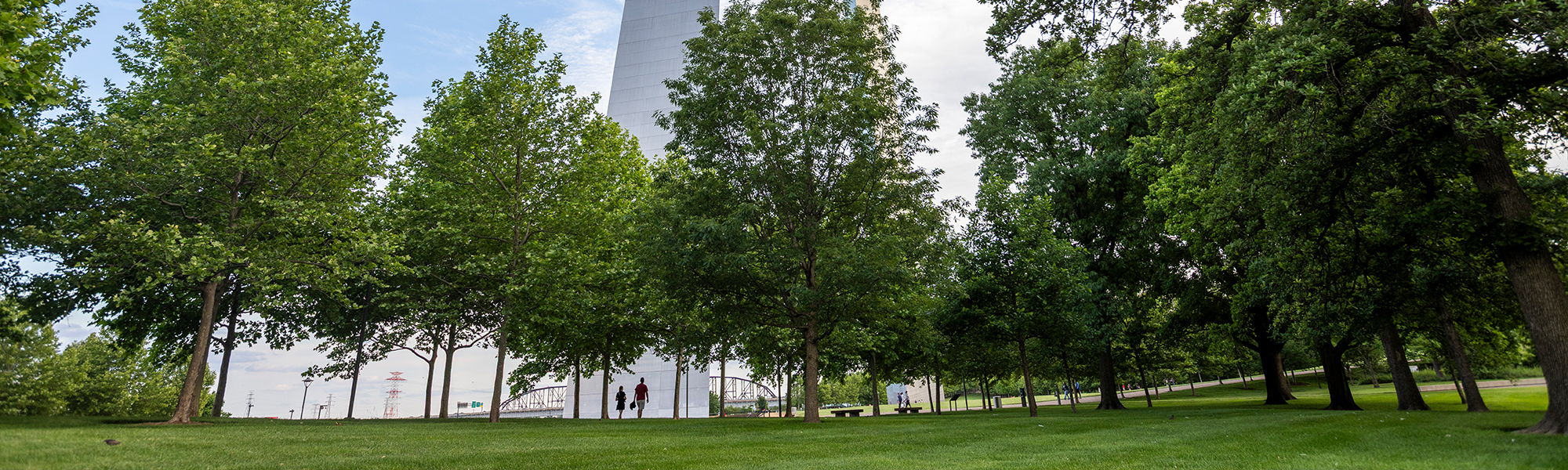
Bald cypress and London plane trees line the walkways in mathematical precision. Freshly mowed lawns glow in the afternoon light. Ponds ripple with the activity of ducks and geese. And everywhere we walk, the Arch presides as a centerpiece not to be forgotten.
May 23–24, 2025
I fly in late to Tulsa, Oklahoma, to visit my brother with plans of journeying northward to St. Louis’ Gateway Arch National Park and Indiana Dunes National Park beyond that. Heading out from Tulsa, we drive 6 hours landing us in the Gateway City around 4:30 p.m. The 630-foot tall landmark peeks above the landscape as we near the park, teasing us with anticipation. After parking in Stadium East parking garage, our first stop is the information desk at the base of the arch to gather our surroundings and chart an itinerary for our short stay in St. Louis.

With a bright blue sky and golden afternoon light, we decide to save the indoor visitor center for rainier weather coming the next day and begin exploring the grounds. A quick walk along the paved footpaths proves Gateway Arch to be the smallest park in the national park system, but no less stunning. We marvel at the meticulous landscaping and lawn care. I know I don’t gravitate towards urban centers very often, but this is easily the most beautiful city park I’ve ever visited. Bald cypress and London plane trees line the walkways in mathematical precision. Freshly mowed lawns glow in the afternoon light. Ponds ripple with the activity of ducks and geese. And everywhere we walk, the Arch presides as a centerpiece not to be forgotten.

We leisurely spend our time taking in every angle of the park. Though it is small in area, the winding circular trails can take a couple hours to stroll. We linger at the ponds watching squirrels, robins, and ducks go about their day. With evening approaching we decide to check in to our hotel a few blocks away, change into some running clothes, and hit the paths to experience the park at a faster pace. Navigating the circumference of the park, we easily complete 4 miles in 2 loops, much farther than we first anticipated.

As night descends, clouds in the west obscure our chance of a sunset, but we still take advantage of the cool blue hour immediately after. At night, the park takes on an entirely new character as city lights reflect on the steel facade of the arch. White lights from a nearby Cardinals baseball game ignite the monument like a sci-fi structure under a bed of stars—seeming to be a tribute to upward expansion as much as westward expansion. Wanting a more expansive scene, we then drive across the Mississippi River to the neighboring Malcom Martin Memorial Park for a riverside view. Unfortunately the stadium lights overpower the scene for any decent photography, but the skyline is still impressive to the human eye.
Returning to the hotel proves to be a challenge as the Cardinals game has ended, leaving us inching along downtown streets in post-game traffic—a variable we would do well to avoid in future visits. The next day brings cloudy skies and a drizzle of rain. But thankfully, we reserved our indoor activities for this morning. Arriving 30 minutes prior to our tram ride up the arch, we are able to explore the incredible underground visitor center while we wait. Again, in all my travels, I am met with perhaps the best visitor center experience yet. Everything from history to culture to science to politics, this visitor center has it all—and in impressive interactive displays no less.

Finally, our time comes and we make our way to the north tram station to board a small 5-person car. The 4 minute ride to the top is surprisingly quick as we ascend 630 feet up the interior of the arch’s leg. The small window in the car reveals the innards of the structure as cables, piping, and stairways drop below us. Atop the arch, we enter a small room with only 16 tiny windows to grant us a view of the earth below. On one side we see the whole of downtown St. Louis. On the other, we are greeted by the Mississippi River and Illinois beyond. We spy pedestrians and cars below us like ants busy at work. Our 10 minutes at the top concludes, signaling our need to pile back in the tram car and ride back down to the visitor center. Though the view is limited and the time is short, we both agree this experience is worth the effort and money.

Back on the ground we make one final stop at the Old Courthouse before bidding Gateway Arch adieu. Inside the courthouse we walk the halls of history where the famous Dred Scott case was tried, inflaming tensions surrounding slavery and ultimately igniting the Civil War. Needing to hit the road, we pack up and head north to Indiana Dunes National Park, reflecting on the symbolism and significance of Gateway Arch. While we still scratch our heads at its induction to the National Park System, we appreciate the questions it forces us to ponder—questions of stewardship, freedom, and forward momentum.

Looking for more?
To view more photos of this park and the rest of America’s 63 national parks, check out my Park Portraits project.